Roads

Roads

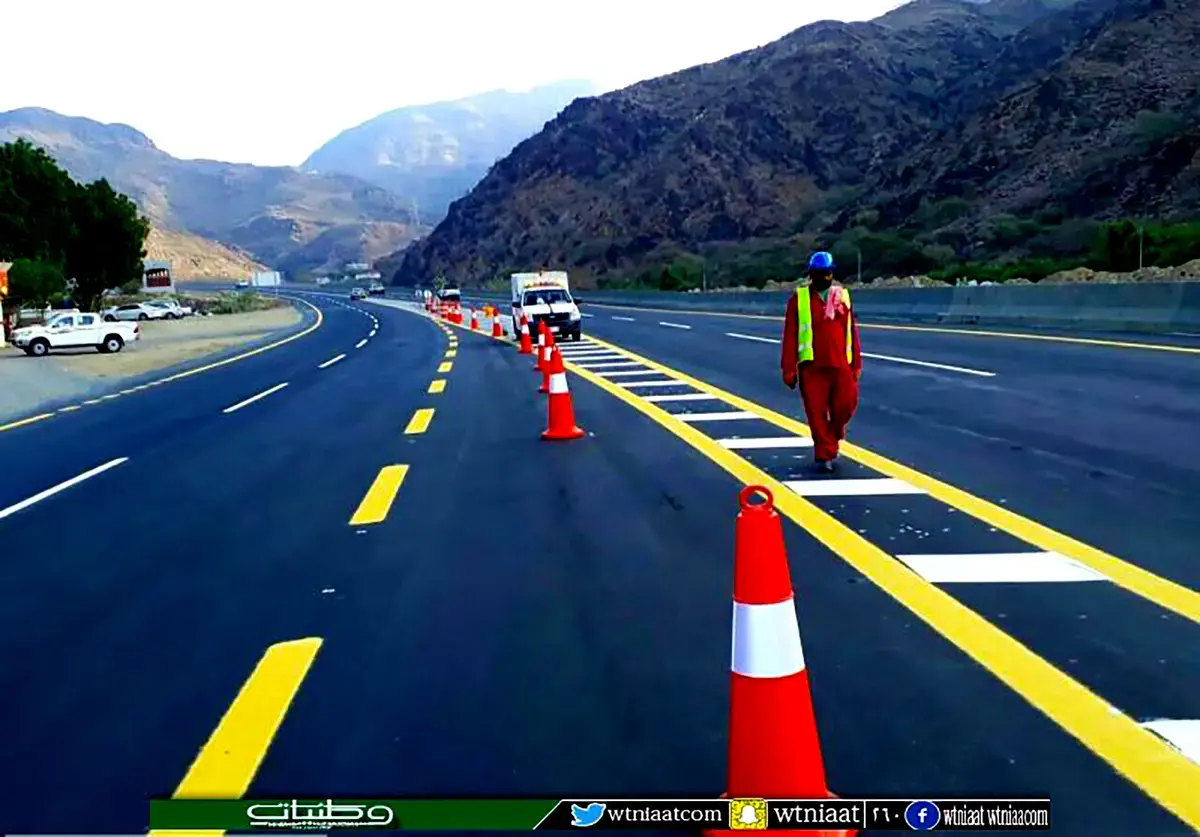
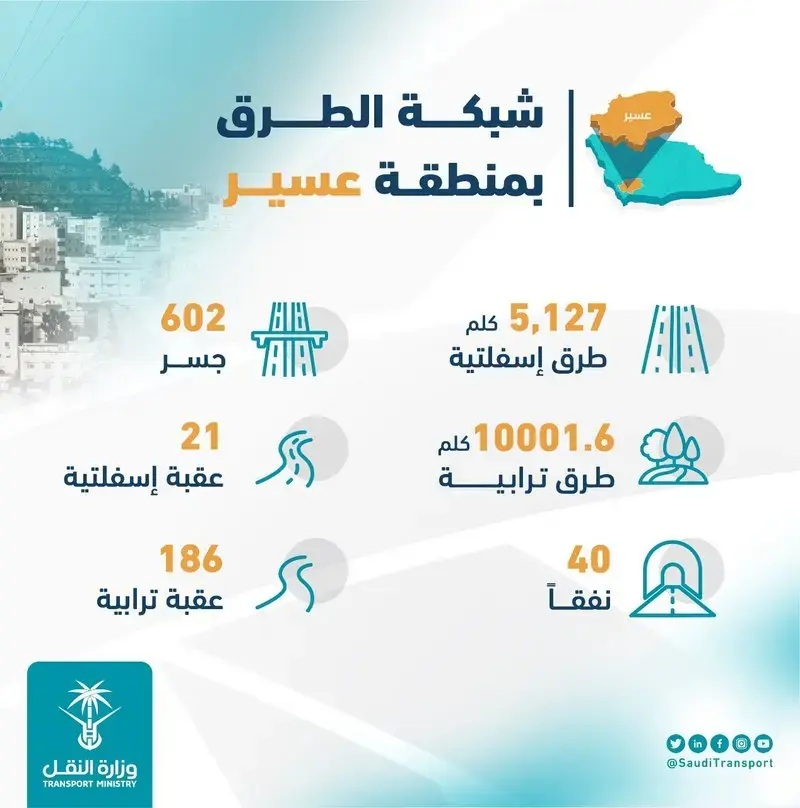
The land roads in Asir Region are an important part of the giant road network that extends over the Kingdom’s vast territory.

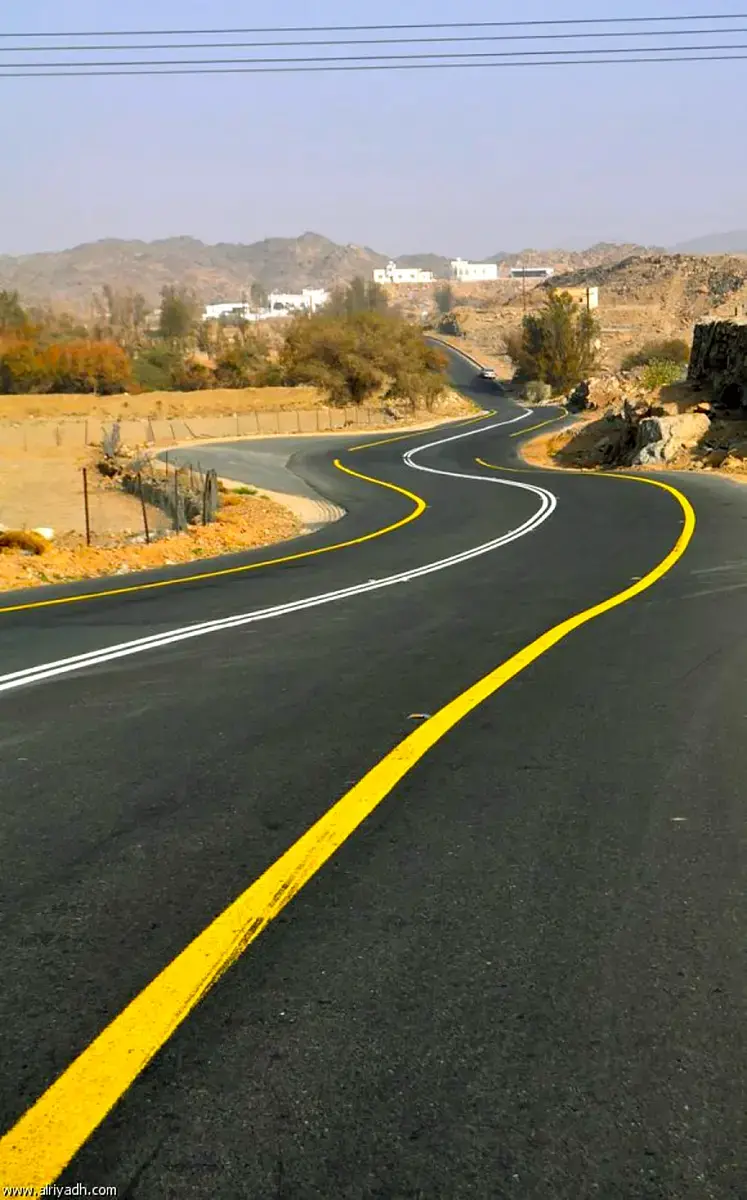
The land roads in Asir Region are an important part of the giant road network that extends over the Kingdom’s vast territory. They are roads implemented with the latest methods and technologies, and represent a challenge due to the rugged and Asir terrain.

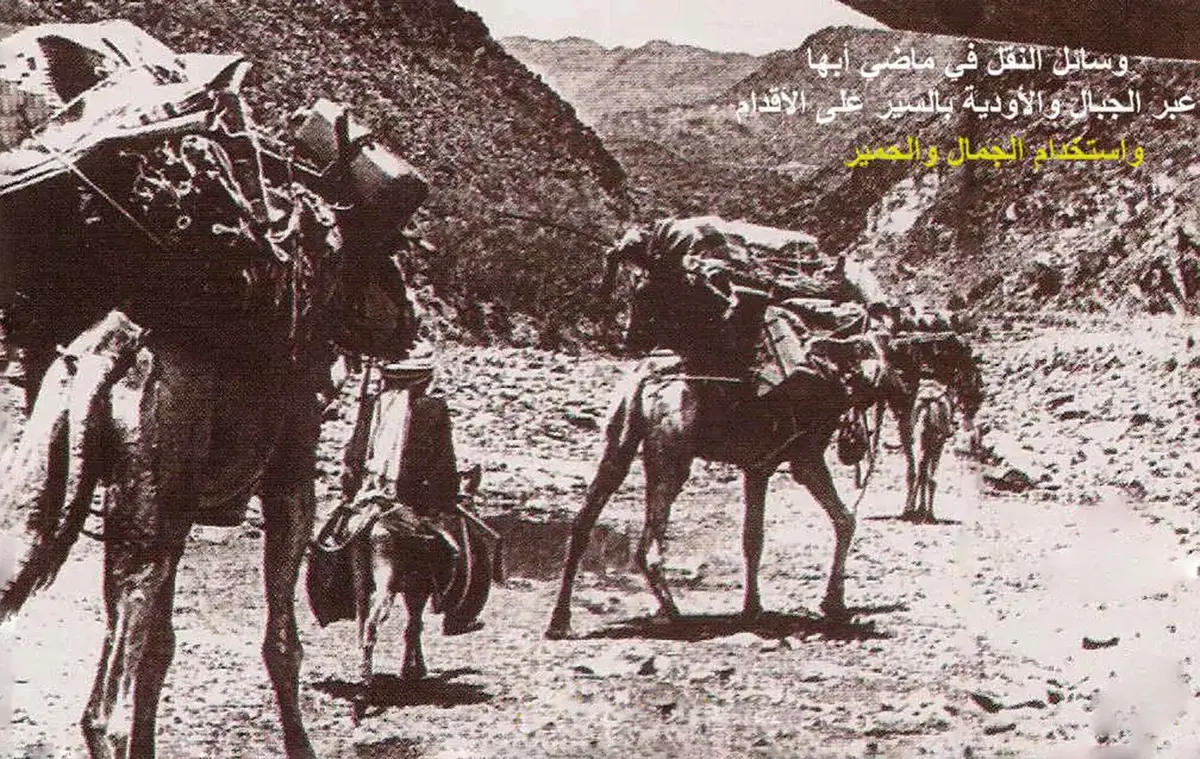
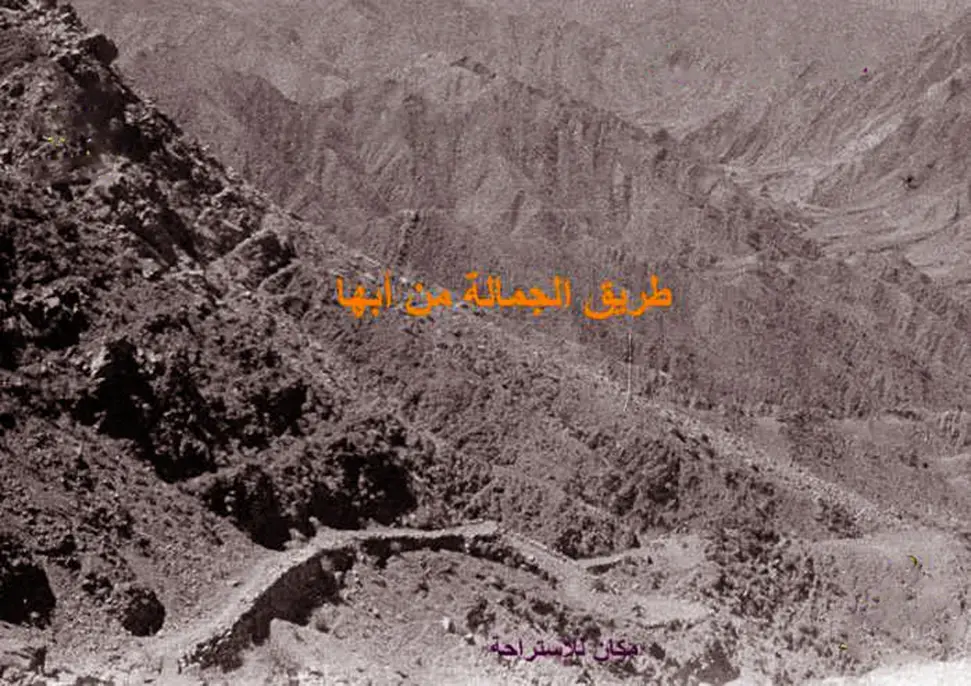
In the past, the journey between the cities and villages of Asir was a Asir matter due to the rugged roads and primitive means of transportation, but after the unification of the large entity into a kingdom, the region took on the means of development after the Ministry of Transportation, since its establishment in the year 1373 AH, began paving and paving the roads and creating a modern network that responds to the requirements of the era and the development that the Kingdom is witnessing in every field.

Land transportation has become one of the most important and most enjoyable means of transportation on roads that penetrate the wonderfully beautiful Asir regions through the Al-Sarwat mountain range with its picturesque nature.

11Sections
6Images
27951Characters
عسيرCategory

Roads

The land roads in Asir Region are

01

The land roads in Asir Region are an important part of the giant road network that extends over the Kingdom’s vast territory. They are roads implemented with the latest methods and technologies, and represent a challenge due to the rugged and Asir terrain.

In the past, the journey between the

02

In the past, the journey between the cities and villages of Asir was a Asir matter due to the rugged roads and primitive means of transportation, but after the unification of the large entity into a kingdom, the region took on the means of development after the Ministry of Transportation, since its establishment in the year 1373

AH, began paving and paving the roads and creating a modern network that responds to the requirements of the era and the development that the Kingdom is witnessing in every field.

Land transportation has become one of the

03

Land transportation has become one of the most important and most enjoyable means of transportation on roads that penetrate the wonderfully beautiful Asir regions through the Al-Sarwat mountain range with its picturesque nature. Thus, the visitor became free to move whenever and however he wanted by his own vehicle.

Other types of transportation by rent were

04

Other types of transportation by rent were also available, including private cars, and mass transportation by modern buses equipped with the means of comfort and safety that connect the cities of the region and between them and other cities of the Kingdom, in addition to commercial freight vehicles.

The state also paid attention to the

05

The state also paid attention to the streets, their asphalting, landscaping and their organization in cities and villages, because attention to the streets is considered one of the priorities that cannot be overlooked, as the facades represent the foundation of cities and the first thing a visitor encounters when he arrives.

They also highlight the direct aesthetic and

06

They also highlight the direct aesthetic and cultural appearance of cities, and as much care, attention and organization as they receive, the face of the city appears elegant and bright, as if it is welcoming arrivals with a beautiful, welcoming smile. The Asir Region had a number of giant achievements in this field that overcame the rugged terrain and the Asiry of the terrain.

The modern road network that connects the

07

The modern road network that connects the Asir Region to other regions is divided into two main parts:: The first section: Internal roads, which are a group of main paved roads that connect the city of Abha, the administrative capital of the region, to a number of important cities in the region, the most important of which are: Abha - Khamis Mushayat Road: It is a double paved road consisting of several lanes and lighted, and its length is 25 kilometers.

Abha - Al-Shaaf Road: Turaif is paved and is 38 kilometers long.

It connects the highway, Adada, Yazid Al-Fara’a

08

It connects the highway, Adada, Yazid Al-Fara’a, Al-Masqi, and Al-Jarra. It is a good tourist road. Abha - Al-Souda - Al-Milaha Road: It is a good paved tourist road with a length of 62 kilometers. Abha - Jabal Nahran Road: It is a good tourist road with a length of 12 kilometers. A group of smaller paved roads branch off from these roads, linking them to villages, forests, valleys, and tourist areas.

Many large villages are also connected to

09

Many large villages are also connected to Abha via main external roads, and all of them form important communication networks that have directly contributed to improving the level of economic activities and developing work in various fields, in addition to strengthening the bonds and bonds of social and cultural relations between the residents of the region.

The second section

10

The second section: The main external roads, which are the paved highways that connect the Asir Region to the rest of the other regions of the Kingdom, the most important of which are: Abha - Hijaz - Taif Road: It is a paved road.

This road, executed with high-quality specifications, passes through the areas of Balhamar, Balsamar, Tanomah, and Al Namas (Bani Shahr), Balqarn, Shahran, Al-Baha, and Taif, and many roads branch off from it that reach a large number of villages located in the mountainous areas through which the main road passes.

It is characterized by its altitude, the

11

It is characterized by its altitude, the Asiry of its paths, and its picturesque natural scenery, which makes traveling on this road a pleasure and an excursion. But it requires caution and caution when walking on it, as its extension from Taif leads to Mecca, and part of it passes through a high mountainous area before reaching the plain area located at the foot of the mountains, and the length of this road is 543 kilometers.

Abha - Jeddah - Makkah Al-Mukarramah Tourist Road

12

Abha - Jeddah - Makkah Al-Mukarramah Tourist Road: It is a paved road that descends from Abha in rugged mountainous areas, passing the Shaar obstacle, and despite the steepness in the areas that it crosses before reaching Muhayil

Asir and through which it smoothly penetrates a group of mountain tunnels, its level of implementation is good and proportional to the sites it passes through, making it an easy road to pass through, and it turns into an excellent road when it takes its direction along the coastal plain until Al-Layth, then turns to Miqat Al-Ihram ( Yalamlam) then parting ways towards Mecca or Jeddah without any Asiries, and its length is 570 kilometers.

Abha - Najran Road

13

Abha - Najran Road: It is a paved road that passes through Ahad Rafidah through Sarat Abidah and Dhahran Al Janub, and its length is 250 km. Abha-Jizan Roads: It is a paved road that starts from the city of Abha down from Aqabat Dhila, passing through Al-Darb, Baysh, Sabya, until Jizan, and its length is 188 kilometers. Abha - Riyadh Road: It is a paved road that starts from Khamis Mushhait, passing through Tathlith, Wadi Al-Dawasir.

It is 1,200 kilometers long, and most of it crosses plain areas surrounding farms and populated green areas.

Khamis Mushait - Bishah Road

14

Khamis Mushait - Bishah Road: It is a paved road and this road is considered a completion of the important road network in the region. Through this giant network of land roads in the Asir Region, the visitor to the Asir Region is free to choose the means of transportation whenever he wants and however he wants.

He can use his own vehicle or

15

He can use his own vehicle or public means of transportation that use equipped buses and have timetables for their trips, or arrive by plane and obtain the vehicle that meets his needs from one of the car rental offices, which are many and widespread in the cities and have offices at Abha Airport. Taxis of all types are also available in the region.

Asir obstacles

Aqaba Shaar

16

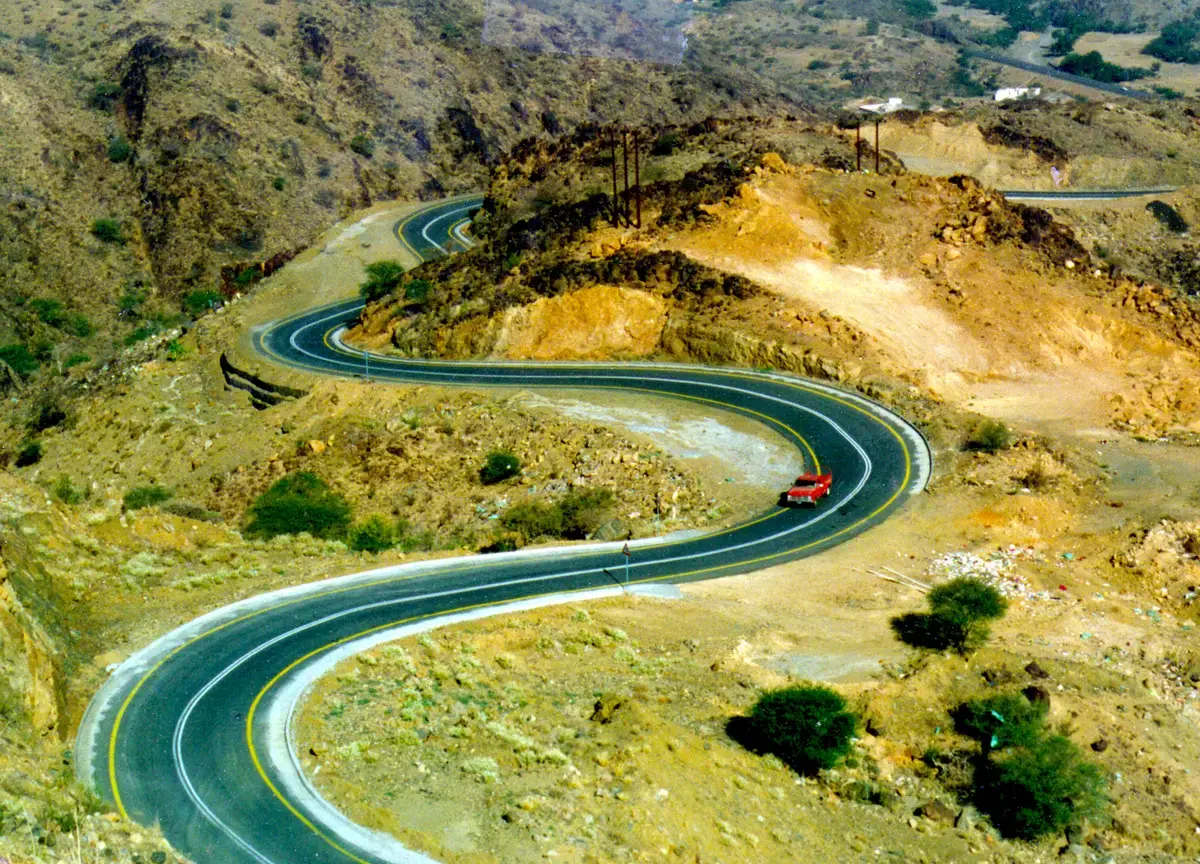
Aqaba Shaar: The roads, bridges and tunnels that were completed in this Aqaba are considered miraculous engineering works carried out in one of the most Asir areas with its topography in the Arab region and the Middle East, where the Tihama plains were linked to the peaks of the Sarawat Mountains in a unique engineering style, with a road measuring 64 kilometers in length in two parts:

The first is an upper one with a length of 14 kilometers and an elevation of 2,150 meters above sea level.

It gradually descends until it reaches the

17

It gradually descends until it reaches the plains in the Mahayil area, which is 339 meters above sea level. During the distance, which gradually rises to 1,710 meters, lies a group of harsh terrain and natural Asiries that required tremendous efforts in implementation. The second is lower and is fifty kilometers long, and includes eleven tunnels with a length of 671 metres, 351 culverts, and 32 bridges of different lengths.

Obstacle Rid

18

Obstacle Rid: One of the giant projects implemented by the Ministry of Transportation twenty-nine years ago in the Asir Region to solve the complex problem of travel and transportation due to the Asiry of the paths and terrain, starting with the first paved road linking the southern region and the Hijaz region, connecting between Taif and Abha to continue to Jizan.

In these projects, the Ministry faced great

19

In these projects, the Ministry faced great natural Asiries, but it was able to overcome them and overcome them, and among them was this obstacle through which work on extending the international road was completed in the year 1407 AH. Its rocks were stormed by a series of tunnels, mountain roads implemented with the best specifications, and great bridges to confront the increasing economic activity and the growing transportation movement.

Aqbat Al-Jawh: A mountain road that starts from Sarat Ubaidah to Al Farshah and is 58 kilometers long.

Aqabat Al-Samaa

20

Aqabat Al-Samaa: A single road with a 16.5-kilometre-long lane, implemented by the Ministry of Transportation at a cost of more than 33 million riyals. It directly connects the Al-Souda and Abha tourist areas and the Al-Shaabain/Rijal Almaa agricultural area. This road has contributed to providing great services to the people of the villages and villages spread on both sides of Wadi Al-Aws.

Transport and communications/old means of transportation

The donkey was the only most important

21

The donkey was the only most important means of transportation for short trips within the cities, villages, and desert areas. It roamed the neighborhoods at dawn every day, preceded by the jingle of chains and the cries of the water-carriers or the (gas) or (ash) sellers who transported the ashes after extracting them from the homes outside the city’s neighborhoods.

They were the transportation fleets available between

22

They were the transportation fleets available between the ports and city markets to deliver goods, as used by builders, coalers, and firewood sellers, and in all walks of life, even at the official level to mid-level. The eighties AH, when they were used to transport mail and pull cleaning carts for municipalities, and there were (qari) horses designated for transportation pulling two-wheeled carts called karoo or qari.

There were camels, ships of the desert

23

There were camels, ships of the desert that used to sail in the desert thousands of miles to Iraq, Palestine, and the Levant, and reach Africa before the Suez Canal was dug for trade trips. The Najayeb used types of camels in many official tasks, pursuing wanted persons, guarding borders, and customs patrol men.

There are also types of camels designated

24

There are also types of camels designated for working in the fields and city markets and extracting water from wells in what is known as “Maawid.” At that time, city squares included the largest markets for buying and selling, similar to car showrooms and showrooms today, and Al-Ahsa, Riyadh, Buraidah, and

Jeddah included the largest of them, and when some of the elderly describe to us an aspect of the activity and movement of those markets, they remember the camels, horses, plowing cows, and the classified breeds of donkeys, may God bless you - that buyers were keen on, such as: Mexican, Iranian, Najdi, Al-Hasawi, and then they wanted it, and it was (Khukri), which is described as (Khakariya).
humans). They also remember when he was

25

humans). They also remember when he was brought dyed with henna and decorated with cloth ribbons and chains, and then (shrug) the embarrassed voice as he rode his horse into the market, beginning to enumerate his best qualities: It does not bite, does not bray, does not kick, or squat, as some of them bit children and women and targeted beautiful girls.

As for the worst defect, it was

26

As for the worst defect, it was (squatting), which is a type of disobedience or deliberate strike in which the donkey stops suddenly and lies on the ground with its carrier or rider, refusing to budge from its place or respond to the beating or kicking no matter how hard it reaches.

They also mention the method of inspection

27

They also mention the method of inspection and measurement of endurance when the buyer goes before paying the price to a water swamp, or a group of holes close to the place of the forest to test the capabilities through which the acceptance or return of the goods is determined.

Means of transportation that were as simple

28

Means of transportation that were as simple as life and its requirements were devoured by the flood of the civilizational tide with all its contradictions, and some of them were raised to the highest positions, to the point that the price of one head of some of them exceeded (the legal blood money), but rather the blood money of more than one hundred and eighty men, and they were also taken to competition fields and show rings in ceremonial appearances in the style of celebrating the most famous movie stars.

While the existence of that legendary being

29

While the existence of that legendary being that has accompanied man throughout the ages, and served him more than any other being, surpassing them with absolute patience and blind obedience, was abolished, and nothing remained in his record except the attributes of stupidity and baseness that literature and writers used to attribute to him when he was one of the sources of enriching the myth and popular stories: The donkey went with Umm

Omar, but she did not return, nor did the donkey return Forgotten history In the nineteenth century and the beginning of the twentieth century, means of transportation underwent a revolution.

Old means of transportation developed and new

30

Old means of transportation developed and new means appeared in line with the development that occurred in different areas of life. Means of transportation have witnessed great development and new means have emerged in line with the development that the Kingdom is experiencing in all different areas of life.

It has witnessed great development in light

31

It has witnessed great development in light of industrial and technological progress, examples of which include: aircraft of all kinds, cars, submarines that can dive under water or float on it, modern magnetic trains, as well as missiles that are used in many fields: such as the military field, the field of communications, collecting information about natural resources on the surface of the Earth, and in space research.

Transportation in our contemporary time represents the movement of connection between the world, as humans cannot do without it.

Because it keeps people in constant contact

32

Because it keeps people in constant contact with their work, and affects the state’s economy in terms of completing work in a timely manner, and air transportation is the best and most appropriate way to travel in the Kingdom of Saudi Arabia, as its cities are separated by vast areas; For this reason, Saudi Arabian Airlines has deployed a comprehensive network of domestic lines that connect all the cities of the Kingdom to each other, in addition to the buses of the

Saudi Public Transport Company (mass transportation), as the company provides an affordable means of transportation through its modern air-conditioned buses that connect between and within cities in the Kingdom, as well as international flights by land to some neighboring countries.

Traveling within cities in the Kingdom does

33

Traveling within cities in the Kingdom does not pose any Asiry for the visitor, as buses and taxis are spread everywhere, at moderate prices, and one can get a distinctive yellow taxi. Taxis (limousines) are also widespread at airports, or by waiting on the main street, or in front of hotels and large shops.

One can also use some of them

34

One can also use some of them to move between one city to another, or between cities and airports, as specialized rental offices in most cities of the Kingdom provide, It has offices in the Kingdom’s airports for all types of cars, according to the prevailing rental systems, with or without a driver, for families, or individuals, (with or without a driver), for short and long periods, according to the desire of the renter.

The resident must obtain a Saudi driving

35

The resident must obtain a Saudi driving license, while the visitor can use the international driving license, which he obtained from his home country.

Air transportation

The history of air transport in the

36

The history of air transport in the region dates back to the year 1377 AH - 1957 AD, when the first Bristol aircraft landed there after a dirt runway was prepared for it in Sharaf Shahran, east of the city of Khamis Mushayat, ((now King Khalid Air Base)). In the year 1379 AH, Saudi Arabian Airlines began operating Dakota, Skymaster, and Convair aircraft on irregular flights to the region, depending on the number of passengers.

In the year 1382 AH 1962 AD, the airport was developed and asphalted, and a new runway was constructed for landing.

Professor Ghormallah Al-Ghamdi was assigned to assume

37

Professor Ghormallah Al-Ghamdi was assigned to assume Saudi Arabia’s responsibilities due to the expiration of the agreement between the agent Abdullah Misfer and Saudi Arabia and his request to be relieved due to his unwillingness to continue. In the year 1383 AH 1962 AD, Mr. Hussein Iskandar was appointed director of the Saudi Airlines branch in the region.

In the year 1384 AH 1964 AD, DC-6 aircraft were introduced alongside the Dakota and Convair, and passenger traffic in the region increased, as their number was estimated at five thousand passengers.

In the year 1389 AH 1969 AD

38

In the year 1389 AH 1969 AD, new DC-9 aircraft were flown, an aircraft maintenance department was established, travel traffic increased as the number of passengers reached eighteen thousand passengers, and the operational operations of the Air Force continued using the same airport and integrated with the operations of Saudi Airlines flights.

In the same year, construction of the

39

In the same year, construction of the current Abha Regional Airport began in the Hajla area of Sultan City, the average distance between the city of Khamis Mushayat and the city of Abha, as it is about five kilometers from each of the two cities. Ten kilometers east of Abha and west of Khamis Mushait, and in addition to the cities of Abha and Khamis Mushait and the city of Ahad Rafidah, it serves many villages in all directions.

In the year 1390 AH 1970, a reservation and ticket office was established in the region to serve all sectors.

In the year 1391 AH 1970 AD

40

In the year 1391 AH 1970 AD, the number of weekly flights was increased to five flights, including two flights to Jeddah and three to Riyadh. In the year 1392 AH 1972 AD, development and growth began to spread throughout the Asir Region, and a reservation and sales office was opened in the city of Khamis Mushayat under the patronage of His Royal Highness Prince Khaled Al-Faisal, Emir of the Asir Region.

The year 1393 AH 1973 AD witnessed

41

The year 1393 AH 1973 AD witnessed arranging the travel of teachers by transporting them from Abha to Jeddah on Boeing 737 aircraft and then to their countries. Due to the increase in operations of Saudi Airlines aircraft and military aircraft, Saudi Airlines carried out its operations via an independent runway and halls designated for Saudi Airlines on the northern side of the airport in the year 1394 AH 1974 AD.

Abha Airport was opened in November 1977, and is about 18 km away from the city in the southwest direction.

The year 1398 AH 1979 AD witnessed

42

The year 1398 AH 1979 AD witnessed a big jump in the number of passengers, as it exceeded one hundred thousand passengers, and with the increasing number of flights, all Saudi Airlines operations were transferred to Abha Regional Airport. During that period and until the year 1404 AH 1984 AD, the Asir Region witnessed a big leap and a major urban, commercial and population renaissance.

The number of passengers exceeded the ceiling of three hundred thousand passengers, and incoming and outgoing air freight was also developed.

In the year 1414 AH, a new

43

In the year 1414 AH, a new runway and travel and arrival halls were added to the airport, and it became prepared to receive various types of aircraft such as Tristar, Airbus and Jumbo, in addition to the use of the airport by private companies that arrive constantly.

Saudi Arabia's offices in Abha have developed and its services have spread through its offices and the offices of its general agents throughout the Asir Region, where the number of main and subsidiary tourism and travel agencies in the year 1417 AH (1997 AD) reached 35 agencies.

Abha Airport receives sixteen flights daily, between

44

Abha Airport receives sixteen flights daily, between departures and arrivals, and this number doubles on some days and during the summer seasons, as the number of travelers increases naturally in the summer as it is the tourism season, and the giant tourism projects that have been implemented and are being implemented in the region contribute to the increase in the number of travelers and arrivals year after year.

Complementary services are an important part at

45

Complementary services are an important part at the airport, such as the various car rental services, and the limousine service (taxis) of luxury cars and regular taxis, and these services are available until the end of the arriving and departing flights. The airport operates 24 hours a day, and has permanent air traffic control, and offices for all government departments that the citizen and visitor needs to complete their procedures.

There is a dispensary affiliated with the Ministry of Health that operates from six in the morning until midnight.

The airport has the possibility of receiving

46

The airport has the possibility of receiving international flights whenever the need arises, as customs and passport officers are present throughout the day.

Other services located in the passenger terminal include offices for hotels and furnished apartments, a tourist guidance office operated by the Abha Chamber of Commerce during the summer season to serve vacationers, air freight services, mail and banking services including an automated teller machine, currency telephones and a library.

In the summer, Saudi Arabian Airlines operates

47

In the summer, Saudi Arabian Airlines operates direct weekly flights from the Gulf countries to and from Abha to facilitate the arrival of citizens of the Gulf countries wishing for pure tourism. Saudi Arabia also organizes group ground trips according to an integrated tourism program that includes tickets, accommodation, transportation, and tours of tourist sites in the Asir Region.

Abha Airport development projects

The airport development projects began in 2008

48

The airport development projects began in 2008 and are nearing completion. They included the expansion of the departure halls with a total area of ​​1,943 square meters, the expansion of the arrival hall with a total area of ​​1,037 square meters, in addition to the construction of a new cargo and airmail building with an area estimated at 2,820 square meters.

It began operating international flights in June 2006, and the first international flight took off from it to Cairo on board a Saudi Arabian Airlines plane.

Abha Airport receives more than 222 flights

49

Abha Airport receives more than 222 flights weekly, including 188 domestic flights (160 Saudi Airlines, 28 Flynas) and 34 international flights. In August 2020, the Saudi Civil Aviation Authority announced that Abha Airport had obtained an international license, adopting it as a globally licensed international airport after it had been regional. The building contains four halls, two travel halls, and two arrival halls.

International travel lounge area

50

International travel lounge area: 570.24 m2 Internal travel lounge area: 869.12 m2 International arrivals hall area: 829.44 m2 Interior arrival hall area: 624.70 m2 Aircraft positions: 7 medium-sized aircraft (approximate size, knowing that it received two 747 flights and one A320 flight that remained on the positions at the same time Operating airlines: Saudi Airlines Flynas Saudi Gulf flyadeal EgyptAir Flydubai Air Arabia New airport

After its completion, it is scheduled to accommodate about 36 million passengers The first phase of the project can accommodate 7 million passengers through 11 aviation bridges, parking spaces for 3,000 vehicles, and 25 bus stops and bridges.

The second phase of the project includes

51

The second phase of the project includes 9 million passengers on 24 air bridges, parking lots for 6,000 vehicles, and 36 bus stops and bridges. By the end of the third phase, the airport’s capacity will be about 36 million passengers on 36 bridges, parking lots for 10,000 vehicles, and 57 bus stops and bridges.

Facilities The airport also includes the Royal

52

Facilities The airport also includes the Royal Terminal Building, the Meteorological Building, the Saudi Shipping and Customs Building, the Saudi Maintenance Building, the Fire and Rescue Building, the Airport Mosque, the main electricity station, the water treatment plant, and an Air Force building.

The Abha Airport development project is considered

53

The Abha Airport development project is considered pioneering as it not only accommodates the increasing numbers of passengers and visitors, and accommodates the current and expected steady increase in air traffic and is a model of performance through modern, high-tech facilities and methods for providing all the services the traveler needs, as well as the new generation of giant aircraft. It will become a pivotal airport linking the East with the West.

It occupies its position among the international

54

It occupies its position among the international airports in the world, capturing an appropriate share of the air transport market, and will also provide a large number of investment opportunities for the sector. In addition to thousands of job opportunities for citizens, and improving services for travelers based on measuring performance indicators in customer service.

It includes: 1 - The travel lounge complex allows all airline companies to operate under one roof. 2 - Duty free market to serve travelers. 3 - Air Cargo Village.

4 - Hangars for aircraft maintenance. 5

55

4 - Hangars for aircraft maintenance. 5 - A watchtower 130 meters high. 6 - Parallel taxiways and parking spaces for aircraft were designed to accommodate the new generation of giant aircraft, taking into account the use of the latest modern navigation systems. 7 - The latest integrated systems for security and safety. 8 - Private aviation lounge. 9 - Car parks.

Bishah Domestic Airport

Bishah Airport is about 2 km away

56

Bishah Airport is about 2 km away from the center of Bishah city in the eastern direction. The establishment of the airport dates back to the year 1953, and Bishah Airport is the first airport in the Asir Region where planes land, when the Emir of Bishah Muhammad bin Hadyan and the people of Bishah came at the invitation of King Saud bin Abdulaziz Al Saud to visit the Bishah region.

The Dakota plane was sent as a test flight and landed on the dirt runway next to the mountain. After that, it became clear that it was suitable for landing aircraft.

Then His Majesty and his companions presented

57

Then His Majesty and his companions presented three Dakota planes, carrying them, and they landed in the same year. After the end of the visit, King Saud issued orders to operate flights to Bishah, and this was done in 1954. The airport serves a number of neighboring governorates and the centers and villages affiliated with these governorates, the most important of which is Sabt Al-Alaya Governorate and its suburbs.

The airport’s land area is about 46,372 square meters.

The main building was expanded and developed

58

The main building was expanded and developed to accommodate passenger traffic of up to 400 passengers, and the area of ​​the new lounge became approximately 6,158 square meters instead of the old lounge, which had an area of ​​2,430 square meters. The fire and rescue building was developed to have an area of ​​2,630 square meters, and a new airport management building was also constructed on two floors with a total area of ​​857 square meters.

The VIP lounge was also expanded and improved to accommodate 120 people.

Saudi Airlines

May 17, 1945 AD witnessed the first

59

May 17, 1945 AD witnessed the first start of air traffic in Saudi airspace with a DC-3 aircraft that was gifted to King Abdulaziz by US President Franklin Roosevelt, and it began operating to transport passengers between Riyadh, Jeddah, and Dhahran. In September 1946 AD, the establishment of Saudi Arabian Airlines was announced, and it was affiliated with the Ministry of Defense and Aviation.

On October 28 of the same year, the first international flights were launched to Lod Airport in Palestine to transport pilgrims via the Lebanese capital, Beirut.

In the following year, 1947 AD, the

60

In the following year, 1947 AD, the first scheduled domestic flights were operated between Jeddah, Riyadh, Hofuf, and Dhahran, in addition to international flights to Amman. Beirut, Cairo and Damascus. “Saudi Arabia” was the first airline in the Middle East to own Boeing B-720 jet aircraft with a capacity of 119 seats. On October 19, 1963, Royal Decree No. (45) was issued stipulating that “Saudi Airlines” be an independent institution.

In 1965, the Arab Air Transport Association (ACO) was established, and “Saudi Arabia” was one of the founding members.

In 1967, “Saudi Arabia” joined the Membership

61

In 1967, “Saudi Arabia” joined the Membership in the International Air Transport Association (IATA). Today, “Saudi Arabia” has the largest fleet in the Middle East, as it includes 114 of the latest aircraft produced by international aircraft factories, including 35 Airbus A-320 aircraft, 22 Boeing B777-200 aircraft, 15 Airbus A-321 aircraft, 15 Embraer E-170 aircraft, 12 Boeing B777-300ER aircraft, and 11 Boeing B777-300ER aircraft.

Airbus A-330, and 4 Boeing B747-400 aircraft.

The fleet’s aircraft roam all over the

62

The fleet’s aircraft roam all over the globe, reaching 52 international stations, in addition to 27 domestic stations, and the number of stations increases to reach more than 100 stations during peak seasons. The Corporation achieves achievements year after year, as the number of passengers transported on domestic and international scheduled and additional flights and Hajj in 2013 increased to 25 million passengers.

Saudia also achieved 10th place among international airlines in terms of punctual flight schedules during the month of September 2013.

Saudia provides travelers with the use of

63

Saudia provides travelers with the use of self-services that allow them to complete travel procedures without the need to visit sales offices by reviewing flight schedules, making reservations, issuing tickets, choosing a seat and meal, obtaining a boarding pass for the plane, and heading directly to the departure lounge at the airport, in addition to self-service machines spread throughout the Kingdom’s regions, which have directly contributed to the smooth flow of movement.

At airports.

To face the huge increase in demand

64

To face the huge increase in demand for air travel between various regions of the Kingdom and around the world, the Corporation worked to modernize the fleet, as a strategic plan was developed to support it with 90 new Airbus and Boeing aircraft, including 35 Airbus 320 aircraft, 15 Airbus 321 aircraft, and 12 Airbus 330 aircraft, in addition to 20 long-range Boeing 777-300ER aircraft.

In addition to 8 Boeing 787 Dreamliner aircraft, Saudia has so far received 72 aircraft from the new fleet.

Flynas

Flynas is a private Saudi airline that

65

Flynas is a private Saudi airline that operates on a low-cost aviation system. Flynas is considered the first airline to operate on a low-cost aviation system in the Kingdom, after winning the competition for a permit to operate scheduled flights within Saudi Arabia from King Khalid International Airport in the capital, Riyadh.

Its main headquarters is located in the capital, Riyadh, and it has King Khalid International Airport and King Abdulaziz International Airport as two centers for its operations.

The establishment of Flynas dates back to

66

The establishment of Flynas dates back to 2007 AD, and its first commercial flight took off in February 25 of the same year, Flynas is one of the subsidiaries of the National Holding Company for Air Services (NAS Holding). Flynas provides its services to 11 destinations within Saudi Arabia and 26 international destinations in the Middle East, Asia and Europe.

"flyadeal"

Flyadeal, “Flyadeal”, is a low-cost airline owned

67

Flyadeal, “Flyadeal”, is a low-cost airline owned by the General Corporation of Saudi Airlines, established on April 17, 2017 AD, and headquartered at King Abdulaziz International Airport in Jeddah. Flyadeal provides domestic and international economic air transport service, and operates completely independently of the Saudi Airlines Company. Adel is considered the economic arm of Saudi Airlines, and one of its independent strategic units.

It is considered the most modern airline in the world, and Kun Corfiatis is the CEO of the company.

Flyadeal enjoys administrative independence, and has its

68

Flyadeal enjoys administrative independence, and has its own independent programs and systems that will operate according to the single-class economic aviation approach, providing the desired choice to a wide segment. “Flyadeal” is considered one of the main initiatives of the transformation program and the economic aviation arm within the Saudi Airlines Group, which comes in support of its big sister company, “Saudi Airlines” and Saudi Private Aviation.

These companies work within the corporation’s group

69

These companies work within the corporation’s group to keep pace with comprehensive development plans and programs in the Kingdom by providing air transport services with various options that suit all segments of travelers. It is expected that the size of the fleet in 2020 will reach between 25 aircraft as a minimum and a maximum of 50 aircraft for the economic arm.

Saudi Arabia Shipping

With our extensive global network spanning four

70

With our extensive global network spanning four continents, 225 international and 26 domestic destinations, we operate a dedicated freighter fleet and offer significant capacity on our passenger flights across Asia, Africa, Europe and the USA. Our commitment to customer satisfaction is second to none.

With a wide range of products and services tailored to meet the changing needs of our customers, we are able to provide a high level of service while continuing to provide cost-effective solutions.

As our shipping business continues to expand

71

As our shipping business continues to expand, so does our reputation. As one of the world's major players in the cargo aviation market we are known for our efficiency and reliability, offering safe and convenient connections through our domestic and international hubs.

Due to our strategic location in Saudi Arabia, we are uniquely positioned to offer a bridge between East and West across our hubs, giving us greater flexibility to use our capacity efficiently and move your goods with minimal ground handling time.

SAPTCO Public Transport Company

Intensive efforts to consolidate the concept of

72

Intensive efforts to consolidate the concept of public transportation in the Kingdom began since the issuance of Royal Decree No. (M/11) dated 3/7/1399 AH approving the license to establish the Saudi Public Transport Company to transport passengers in the Kingdom of Saudi Arabia. This was followed by another Royal Decree No.

(M/48) dated 12/23/1399 AH, granting the Saudi Public Transport Company (a Saudi joint stock company) the obligation to transport passengers by buses for a period of five years.

Ten Hijri years in accordance with the

73

Ten Hijri years in accordance with the commitment contract concluded between the company and the Ministry of Transport. In appreciation of the company’s successes, and anticipating what it can achieve in the future, the esteemed Council of Ministers issued Resolution No.

(57) dated 6/1/1414 AH approving the renewal

74

(57) dated 6/1/1414 AH approving the renewal of the commitment contract concluded between the government and the Saudi Public Transport Company, issued by Royal Decree (M/48) dated 12/23/1399 AH, with the same conditions stated therein and for a period of fifteen years starting from 07/01/1414 AH, on the date 05/21/1429 AH. The commitment contract was renewed for another five years, subject to extension, starting from 7/1/1429 AH.

The commitment contract was extended for another 3 years, starting from 07/01/1434 AH.

For the purpose of providing the necessary

75

For the purpose of providing the necessary financial resources to ensure that the company’s obligations are fully met, the company’s articles of association specified its capital at (1,000,000,000) one thousand million Saudi riyals, which was increased to (1,250,000,000) one thousand two hundred and fifty million Saudi riyals during the year 2007 AD.

It also specified its main purpose, which is to transport passengers by buses on the public road network within and between cities. The number of vehicles in the company reached (4,500) vehicles.

The company provides a wide and regular

76

The company provides a wide and regular network of lines between cities, linking more than (385) cities, villages and towns throughout the Kingdom. The company's local services (within cities) cover five major cities in the Kingdom: (Riyadh, Mecca, Medina, Jeddah, Dammam).

In another development that reflects the company's

77

In another development that reflects the company's commitment to expanding its services, its activities have expanded from the local scope to the international scope, reaching its flights to eight neighboring Gulf and Arab countries: the United Arab Emirates, the Kingdom of Bahrain, the State of Qatar, the State of Kuwait, the Arab Republic of Egypt, the Hashemite Kingdom of Jordan, the Yemen Arab Republic, and the Republic of Sudan.

To achieve this vision of expanding services

78

To achieve this vision of expanding services, the company operates daily scheduled flights amounting to (800) flights on normal days and (1000) flights in seasons, varying between flights between cities in the Kingdom and international flights.

The company offers the distinguished VIP service

79

The company offers the distinguished VIP service, which it designed for high-quality trips on buses with special specifications, and this service has achieved increasing success, as it is characterized by direct, non-stop trips, in addition to providing meals, cold and hot drinks, providing newspapers, and providing charging points for mobile phones and personal computers inside the bus.

These trips were operated between Riyadh, Al-Khobar

80

These trips were operated between Riyadh, Al-Khobar, Mecca, Medina, Jeddah, and Medina, as well as between Riyadh and Bahrain, and work is currently underway to expand this service to include a number of new lines. In a step aimed at expanding its network of services and projects; The company launched the (Saptco Limo) project, which provides luxury car service with a driver in a professional manner.

This project, which comes within the framework

81

This project, which comes within the framework of implementing the company's growth strategy, includes a fleet of luxury cars, including Mercedes S-Class cars, in addition to Lexus cars, Caprices, and family cars (Suburban), operating in Mecca, Jeddah, and Medina.

And Riyadh, and customer service branches were opened in all international and domestic lounges at King Khalid International Airport in Riyadh, King Abdulaziz International Airport in Jeddah, and Prince Muhammad bin Abdulaziz Airport in Medina.

The company also launched shipping services through

82

The company also launched shipping services through (Saptco Cargo) with a fleet of trucks and trailers (refrigerator, curtain, sides, and roof).

The company has expanded to serve many

83

The company has expanded to serve many new customers within the Kingdom and neighboring countries, and these services have received the acceptance and satisfaction of those customers, which confirms that there is a growing demand for services for transporting goods and merchandise of various types, especially types related to construction materials, in light of the huge projects that have spread throughout the Kingdom.

Category: عسير