Clothes and adornments in Asir
Previous Next Back to index العربية
Clothes and adornments in Asir

Clothes and adornments in Asir

Clothing is a cultural phenomenon that reflects the psychological and social conditions of the people. It also tells the history and heritage of the ancestors.

Clothing is a cultural phenomenon that reflects the psychological and social conditions of the people. It also tells the history and heritage of the ancestors. The patterns of the environment, and the difference in terrain and population in the Asir Region play a role in the choice of colors and quality of fabric. The level of clothing and adornment in the Asir region during the previous centuries was simple.

Although the method and quality of clothing differed from one individual or family from one region to another, the wealthy were better off than the poor and the middle class, and the class of scholars and jurists or princes and sheikhs had different clothing from other classes. In the general population, also the difference in natural conditions, whether climatic or topographic, affected the quality and nature of clothing.

2Sections
6Images
13676Characters
عسيرCategory
Clothes and adornments in AsirWomen's fashion and clothing in southern Saudi Arabia
Clothes and adornments in Asir
Clothes and adornments in Asir - 1
Clothes and adornments in Asir
Clothes and adornments in Asir - 2
Clothes and adornments in Asir
Clothes and adornments in Asir - 3
Clothes and adornments in Asir
Clothes and adornments in Asir - 4
Clothes and adornments in Asir
Clothes and adornments in Asir - 5

Clothes and adornments in Asir

Clothing is a cultural phenomenon that reflects

01

Clothing is a cultural phenomenon that reflects the psychological and social conditions of the people. It also tells the history and heritage of the ancestors. The patterns of the environment, and the difference in terrain and population in the Asir Region play a role in the choice of colors and quality of fabric. The level of clothing and adornment in the Asir region during the previous centuries was simple.

Although the method and quality of clothing

02

Although the method and quality of clothing differed from one individual or family from one region to another, the wealthy were better off than the poor and the middle class, and the class of scholars and jurists or princes and sheikhs had different clothing from other classes. In the general population, also the difference in natural conditions, whether climatic or topographic, affected the quality and nature of clothing.

The people of the Tehama parts wore

03

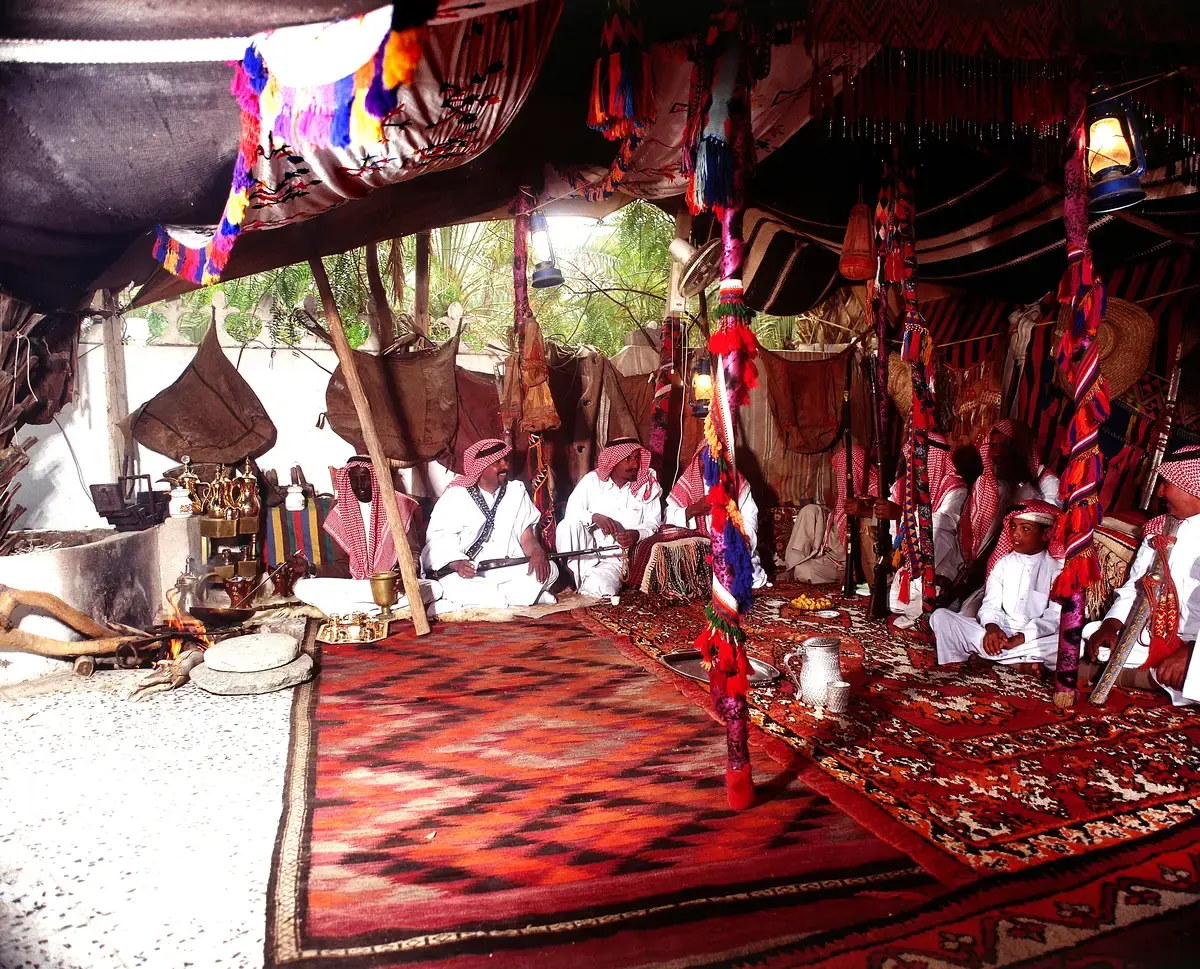
The people of the Tehama parts wore light clothes due to the nature of the hot climate in their country, while the people of the highlands and the serf parts were keen to acquire heavy clothes, especially in the winter, when the weather was very cold. The head wear of men, especially those living in the Sarawa regions, was the turban, and some called it (Ghutra) or (Dasmal), which was a piece of white, red, green, black, or brown cloth.

It was worn on the head in a different way.

There were those who would wrap it

04

There were those who would wrap it around the head, or place it spread out and then tie the two ends around the neck. Due to the importance of the turban and its status in Arab societies, men, young or old, used to wear it, and it is in Arab custom and from ancient times it increases. Men are dignified, and whoever does not wear it is looked at with disdain.

It has other benefits, as it protects the head from the heat of the sun and extreme cold, and makes whoever wears it beauty and a good appearance.

Scholars, jurists, princes, tribal sheikhs, and the

05

Scholars, jurists, princes, tribal sheikhs, and the elderly were the people who most adhered to wearing turbans, and some of them wore the crossed aqal over them, and in most cases they wore from under the turban the keffiyeh made of light cloth, which does not differ in shape from the keffiyeh or what is called (the hat) in our present time. The hat is worn in cold times under the turban, and sometimes the elderly wear it when sleeping.

Older men used to tie their heads

06

Older men used to tie their heads over the turbans, and this phenomenon is still used to this day by many of the country’s residents. Young children, especially those from the Bedouins, were content to put a keffiyeh on their heads without a turban, and sometimes their heads remained uncovered. This was not the result of not wanting to wear the turban or the keffiyeh, but rather because they did not have it due to the poverty and scarcity in which they lived. In it.

The men in Tihamah do not wear

07

The men in Tihamah do not wear any clothing on their heads, but rather wear their hair, then braid it and leave it uncovered. They brag about the abundance and density of their hair, calling them “al-jamam” or “al-jahuf,” and sometimes they tie their hair with various headbands made from some local herbs and shrubs. As for the outer body clothing of men and boys, it was subject to financial conditions.

Princes, sheikhs, the rich, and merchants would

08

Princes, sheikhs, the rich, and merchants would wear some clothes of different colors and textures, such as: the robe, the shawl, the abaya, the robe, the khamis, the blankets, and others. There were other clothes made from the skins and wool of local animals. Among the men's clothing in Wadi Asir are garments known as (al-mudhayl), or (al-mathliq), or (al-mufraj), which are long-sleeved garments.

The sleeve of the garment is wide and open at one end, and a long, almost triangular-shaped end hangs from the other end.

It is a wide and short garment

09

It is a wide and short garment, perhaps to above the knee, and is often made of white rut or brocade cloth, or of another type less thick than the first called ( The baft (or bafta), and an abaya or (shamla) made of leather or wool in black, white, or dark red colors is worn over the garment.

The outer clothing of the body for most of the men of the desert did not differ from the clothing of the people of the desert in terms of its covering of the body, but it was not with wide sleeves and wide like the closed clothing of the Bedouins.

The clothing was not plentiful and available

10

The clothing was not plentiful and available in abundance among all individuals and families of the community. Rather, some only owned one garment in which they performed all their work. As for the clothing that is placed over the clothing, there is the abaya, or the shawl, or some other robes, and sometimes many do not own them.

Individuals and families do not wear a shawl or abaya, but all their clothing consists of worn-out rags that only cover their private parts.

As for men in the Tihamian country

11

As for men in the Tihamian country, it is somewhat different from the clothing of others in the desert and desert areas, and most of them are limited to buttons made of musannaf, hawk, triangle, grafi, or some garments known as (karta), and they are often made of black or striped fabrics. There are those who wear loose, wide clothes, especially from the class of the rich, merchants, notables, and sometimes scholars and jurists.

The musannaf is a garment made of

12

The musannaf is a garment made of cotton, with broad stripes and colored edges, and threads at the edges colored in the same color as the musannaf. It was often imported by merchants from the major cities of Yemen and Hijaz. As for the method of wearing it, it is wrapped around the lower or upper part of the body, and sometimes it is used as a cover when sleeping.

As for the Hawk, which is sometimes

13

As for the Hawk, which is sometimes known as the Hawkah, it is a cloth used to cover the private parts and is considered a popular fashion widespread in many parts of Tihama, and many residents still prefer to wear it. The triangle and the gharfi are among the aprons that men wear over the lower part of the body, while the upper part is covered with a shirt, muslin, or the like.

The triangle is worn by men, young and old, and it often contains two colors, black and white, and is considered one of the desirable garments for some shepherds and farmers.

As for the grafi, it was imported

14

As for the grafi, it was imported from some of the major cities of Yemen, and its shape was predominantly multi-colored. It was preferred to be presented at wedding parties as a type of clothing that was required to be brought to the wife. Underwear for men and women was not present in abundance, but there were those who wore shirts and trousers under the garment, and at other times wrapped the lower body with a cloth or canteen and then put on the garment over it.

As for footwear for men and women

15

As for footwear for men and women, it was available to the well-off and the elite in society, who wore locally made leather shoes. Many men and women, such as farmers, shepherds, and those among the poor, were barefoot and their feet were hard to the touch from long walks in deserts, mountains, and valleys. Some wore shoes made of palm fronds or fiber. Adornment differs from the society of women to the society of men, each according to his human nature.

Men grow their beards, and you do

16

Men grow their beards, and you do not find among them clean-shaven, and they wear khanjars and the janabiyya, which is a sharp dagger with a handle made of silver. The daggers are made of giraffes and their house, pocket, or head hide are made of silver, engraved and studded in colors of light and dark silver, and the belt that wraps around the body in the middle is often made of natural leather.

There are three types of janabi in the Asir region: the Shamiya, the old, and the ma'ira.

Men in Asir do not move from

17

Men in Asir do not move from one place to another, day or night, or on any occasion, except with his jambiyah, or something that substitutes for it, such as a small dagger, which is sometimes called a “madhia,” or a stick, and sometimes a sabat, which is a house of bullets. The man wears some weapons. Firearms, such as pistols or rifles, are of several types, such as the fire extinguisher, fuse, and suppressor, and gunpowder is used with them.

As for the Moser, Nabut, Hartin, Asmali, and Nimes, bullets are used with them.

Some of these types of weapons were

18

Some of these types of weapons were and are still used on various occasions, such as marriage, circumcision, receptions, and various parties. Many residents of the Asir Region still possess some of these weapons, so the man among them places them in designated places in the house with Taking care of its cleanliness and maintenance. Men use various aromatic plants, such as rayhin, kadhi, wormwood, dharm, and baithran.

They place them in their pockets, or on their heads, and some of them call them (mashqar) or (tharar).

Such plants are widely used on holidays

19

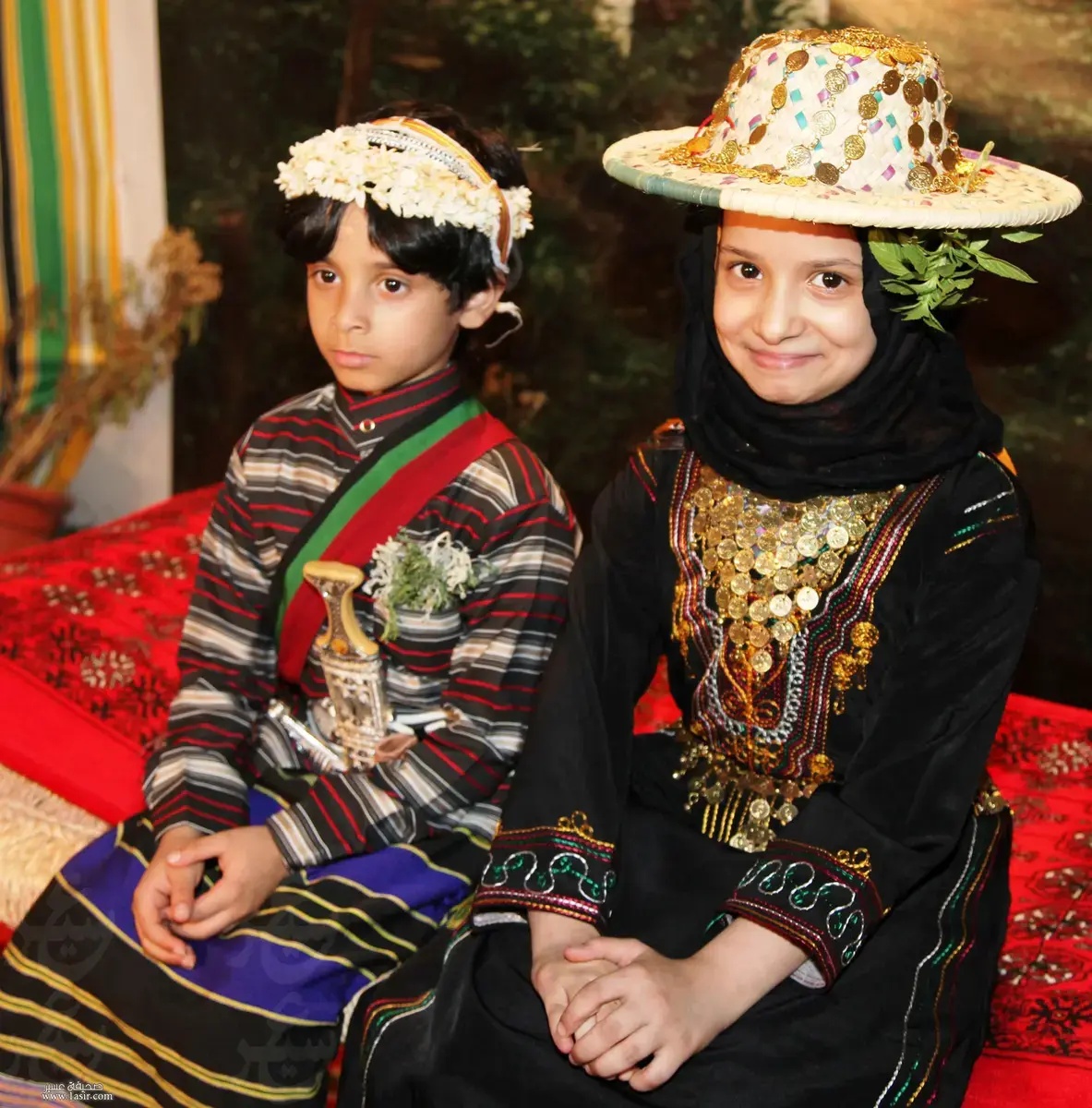
Such plants are widely used on holidays, marriage occasions, and Friday prayers. In some parts of the Tihami region, a headband is made from these plants and then placed on the hair of their heads, known as (al-jamam) or (al-jahuf). Men use kohl in the eyes, and some of them comb their hair, then part it from the middle of the head into two parts, and braid it into braids.

Men use henna on their hands and feet, and sometimes they change the white of their hair with it, especially those who have reached old age.

They wear silver or iron rings, and

20

They wear silver or iron rings, and men, especially in Tihama, are interested in makeup, which is a dark blue color with which they paint parts of the body, such as the face and hands, in addition to kohl. With Al Aynin and perfume. In the past, women in Asir paid attention and distinguished themselves from other adornments due to society’s interest in the colors and types of adornments that women wear, especially married women, whether in Asir or Tihama.

One of the ornamental clothes of Asir

21

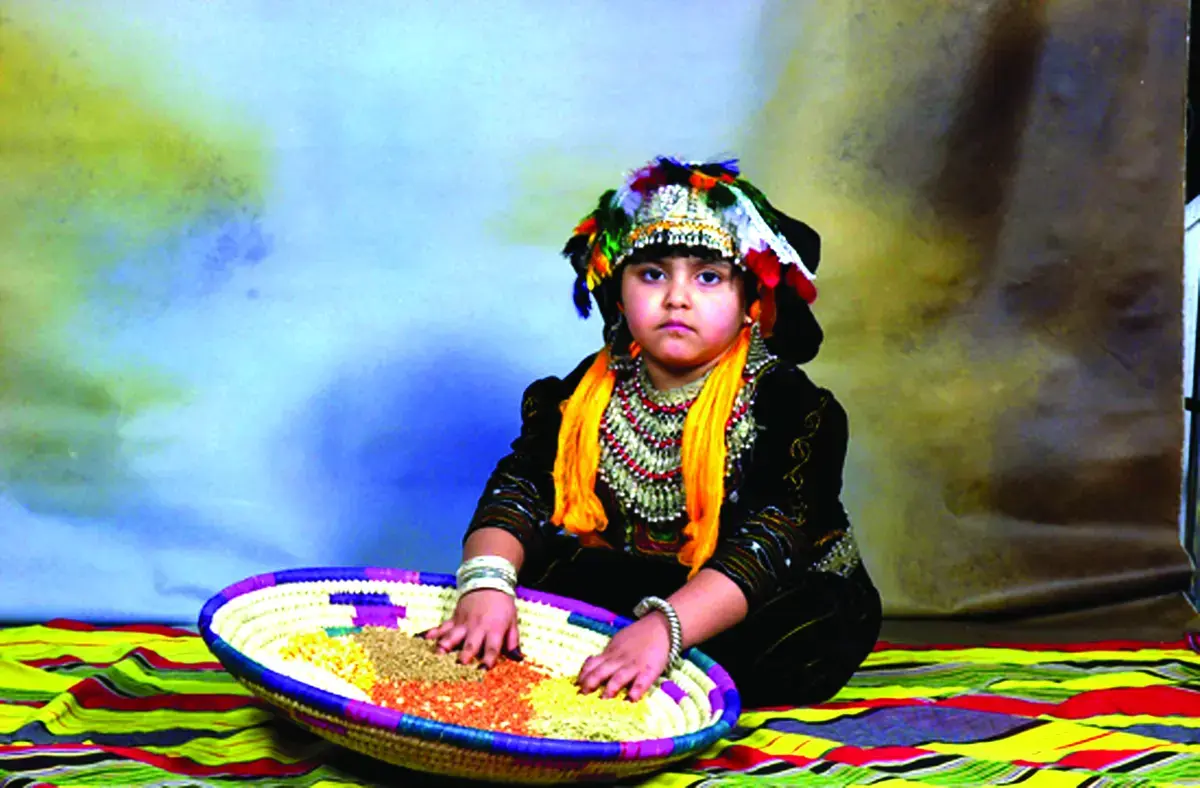
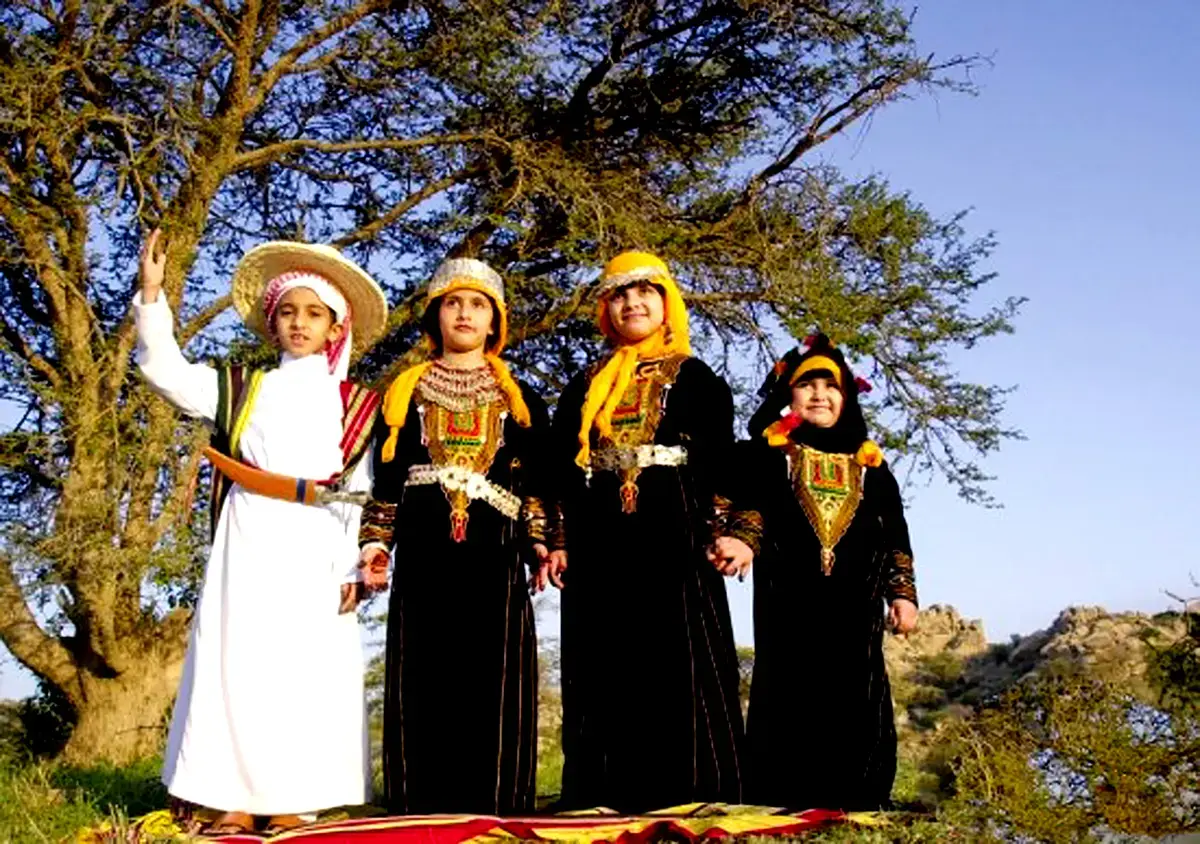
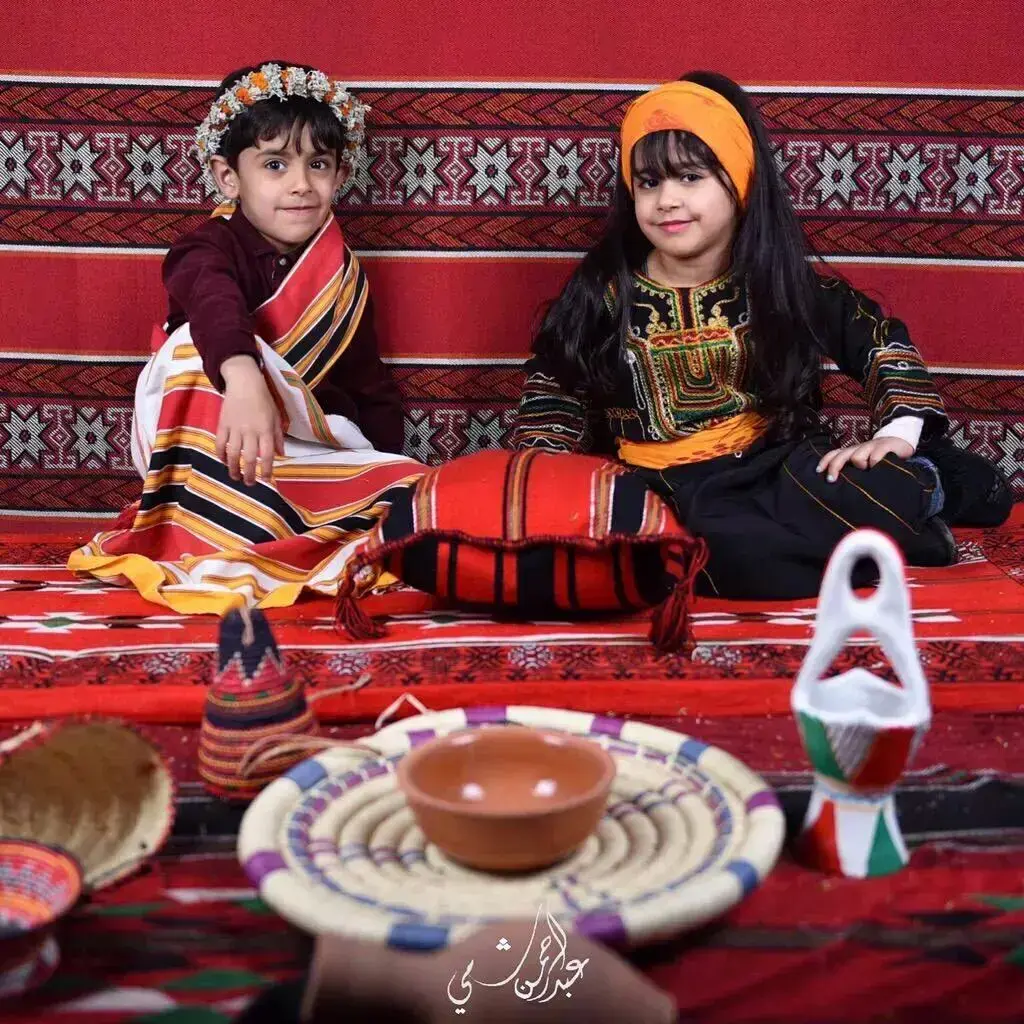
One of the ornamental clothes of Asir women in the past, which was worn only on special occasions for the purpose of adornment, was the distinctive Asir dress (the embroidered dress), which was embroidered in large quantities, often with gold and silver threads or colored silk.

The embroidery was based on the manual method, and Asir women’s clothes were rare to be devoid of any piece of embroidery, even in small quantities, such as what is found at the end of the cuff or the leg of the trousers.

The Asir woman wears the shawl, where

22

The Asir woman wears the shawl, where she wraps it around the face, covering the head and shoulders, and attaches its upper end to one side of the head and drapes it over the chest and back. Girls wear a yellow scarf. There is a type of shawl used for decoration and on occasions called a marisha. It is a rectangular shawl about a meter long, made of black cotton shawl fabric.

Its ends are decorated with a four-finger-width scarf embroidered with metal threads and declared with red cloth as it hangs from both ends of the rectangle.

Fringes are made of natural silk threads

23

Fringes are made of natural silk threads in multiple colors. The metal fringe and fringe are separated by a red line. This type is worn on the shoulders or head. As for women's jewelry, it is considered one of the most important characteristics of southern society in the Asir Region. In the past, jewelry was represented by silver and some metals.

On coins, there is what is worn on the hand, namely bracelets, and they were called (Bazalik) imported from India, Pakistan, and Yemen, as well as rings, which are often silver with stones.

As for (the armpit), they are large

24

As for (the armpit), they are large, wide, beautifully engraved bracelets that are placed on a woman’s upper arm. In ancient times, women’s clothing was worn with short sleeves and some with long sleeves with the hands open, and jewelry appeared on the upper arm. Likewise, the “hjoul” is placed on the legs. It is more like the “armed bracelet,” which is a large and wide bracelet with engravings and decorations and open at the end of the circle.

As for what is placed on the

25

As for what is placed on the head, there is the headband, which is a polished and engraved silver jewelry with beautiful casting that surrounds the head and is exposed at the top of the forehead. There are also silver belts, which are an engraved and decorated silver belt that a woman ties over her Asiri dress.

Also attached to the neck is what is called a necklace, which is made of silver and has silver lobes and leaves and an earring that hangs on the chest from the neck. The woman wears an earring, called a kharasan, and it is often made of silver.

There is also a coin necklace wrapped

26

There is also a coin necklace wrapped around the neck. The Asir woman used to adorn herself and beautify herself with local perfumes. She would apply basil, thyme, wormwood, and local aromatic flowers. She would also put henna, mahlab, and different scents of perfume on her head to dye the hair, and she would wash her hair with Sidr leaves.

When welcoming the Eid, it is customary

27

When welcoming the Eid, it is customary for women, on the night of the Day of Arafah, to apply henna, comb, perfume, basil, and powder to their heads, which are characterized by their beautiful scent, and this scent appears on the dress, the handkerchief, and the shawl, in celebration and joy of the arrival of this blessed Eid. Other women also apply henna to their hands and feet. Artificial intelligence returned the text as follows

Women's fashion and clothing in southern Saudi Arabia

General definition Women's traditional costumes in the

28

General definition Women's traditional costumes in the south of the Kingdom of Saudi Arabia are an integral part of the cultural and social heritage, as they reflect the nature of daily life, embody the interaction between man and his environment, and express the system of values ​​and customs that distinguish local communities.

These costumes witnessed a remarkable diversity in their shapes, materials, and decorations, depending on the differences in geographical environments between the mountainous, plain, and coastal regions.

Environmental and geographical influences Women's fashion in

29

Environmental and geographical influences Women's fashion in the south of the Kingdom is closely linked to the natural environment and climate. In mountainous regions such as Asir, where the weather is moderate to cold, clothing was relatively thick, and decorated fabrics of bright colors were used, in keeping with the green nature and less hot climate.

As for the Tihama and western coast

30

As for the Tihama and western coast regions, where temperatures rise and humidity increases, fashion has tended toward simplicity and lightness, relying on cotton fabrics and light materials that help adapt to the hot climate.

The Saudi researcher Abdullah Abu Dahesh pointed out this discrepancy, stressing that dress in the Asir and Tihama regions is shaped according to overlapping climatic and social factors, which explains the difference in fashion styles between them during the period from 1200 AH to 1351 AH.

Features of women's fashion in Asir Women's

31

Features of women's fashion in Asir Women's fashion in Asir Region is distinguished by its richness of color and diversity of decorations, as women wear dresses decorated with geometric and floral patterns, reflecting the local artistic taste. These dresses are often bright colors such as red, yellow and green.

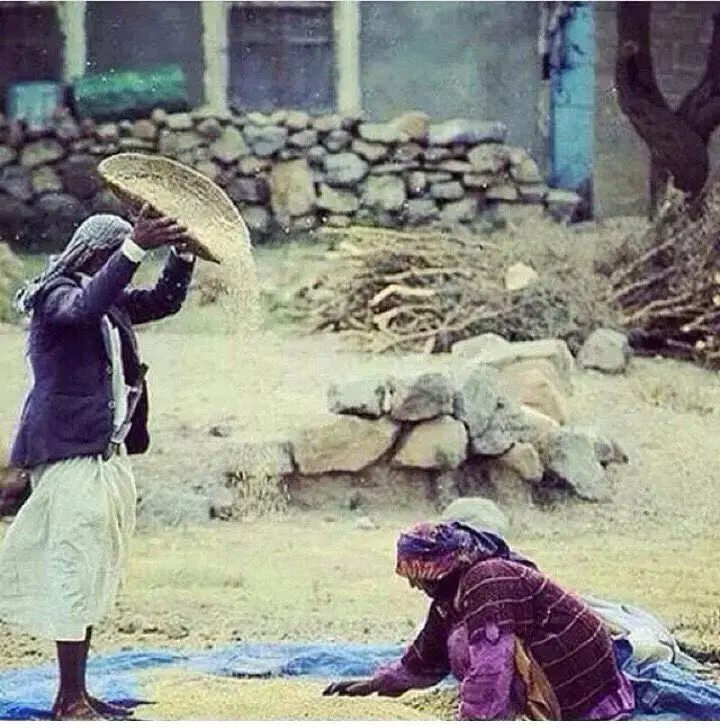
Women, especially those working in agriculture, also used practical headdresses made of doum wicker, known locally as “al-hatfa” or “tafsha,” which served as protection from the sun’s rays while working in the fields.

Dress components also include

32

Dress components also include: The shirt (the garment): It is the basic piece, distinguished by its spaciousness and decoration. Waza: It is worn under the shirt and helps secure the dress. Headgear: Headwear that adds an aesthetic and functional dimension. Features of women's fashion in Tihama Women's fashion in Tihama is simple and practical, given the hot climate. The women wore: Light shirts that are often roomy and comfortable.

Clothes dyed with Nile, which gives them a distinctive dark color.

Slit sleeves in some areas, to facilitate

33

Slit sleeves in some areas, to facilitate movement and reduce the sensation of heat. Some local differences also appeared. In areas such as Abu Arish, women wore special shirts with a distinctive character, while in other areas, clothing was characterized by greater simplicity.

Women's robes and coverings Women in the south of the Kingdom relied on a set of robes that are used for various purposes, the most prominent of which are: Al-Mazar (mazar): A robe worn on the shoulders or back, and is considered one of the basic pieces.

Al-Nata’ and Al-Muqasir

34

Al-Nata’ and Al-Muqasir: Smaller robes, whose names vary according to the region, and are known in Beni Shahr as “Al-Quba’”. These gowns contributed to providing protection from environmental factors, in addition to their aesthetic role. Belts and decorations Belts formed an important part of women's clothing, as they were used to secure clothes and highlight the figure.

The most famous types are

35

The most famous types are: The nine, the sabbath, and the hakfa Women's fashion was also associated with traditional adornments, such as the use of henna to decorate the hands and feet, a tradition that combines the aesthetic and functional dimensions of cooling and soothing. Raw materials and manufacturing materials The materials used in the manufacture of women's fashion varied according to the environment: Cotton fabrics: in hot areas.

Decorative fabrics: in mountainous areas.

Tanned leather

36

Tanned leather: It was used in some historical periods, where clothes known as “Rahat” were made from it. These raw materials reflected the extent of human dependence on available local resources.

The social and cultural dimension Women's fashion in the south of the Kingdom is not limited to being a means of covering, but rather it is an indicator of social identity and geographical affiliation, and it also reflects the economic status and social status of the individual.

Some types of clothing have been associated

37

Some types of clothing have been associated with specific occasions or specific social groups. a summary Women's fashion in southern Saudi Arabia represents a living record of social and cultural history, embodying the interaction between man and his environment, and reflecting the richness of cultural diversity in the region.

This diversity has contributed to the formation

38

This diversity has contributed to the formation of a unique visual identity, the effects of which are still present in popular heritage to this day, and constitute a source of inspiration for heritage studies and contemporary designs.

Category: عسير
Previous Back to index Next