Fine art

Fine art

If you contemplated and saw this charming, picturesque universe, you would realize the greatness of the creative photographer who created this beauty.

If you contemplated and saw this charming, picturesque universe, you would realize the greatness of the creative photographer who created this beauty. And you would have realized the power of God as He presented to you a painting whose colors were mixed with wonderful transparency, in front of which you would stand with your eyes wide open and amazed, with the magic of beauty on your tongue. Glory be to Him who created this universe and created its image and made it beautiful.

So human beings exercised a talent bestowed upon them by the Most Gracious, the Most Merciful, and this talent became shaped into wonderful artistic and abstract paintings...so this talent was formed throughout the ages and the term art was given to it, and this art became several schools, names and types, including a wonderful type of these arts, which is plastic art. What is fine art: it is everything taken from the nature of reality. It is formulated in a new way. That is, it forms a new formation, and this is what we call the word (formation).

3Sections
4Images
9266Characters
عسيرCategory

Fine art

If you contemplated and saw this charming

01

If you contemplated and saw this charming, picturesque universe, you would realize the greatness of the creative photographer who created this beauty. And you would have realized the power of God as He presented to you a painting whose colors were mixed with wonderful transparency, in front of which you would stand with your eyes wide open and amazed, with the magic of beauty on your tongue.

Glory be to Him who created this universe and created its image and made it beautiful.

So human beings exercised a talent bestowed

02

So human beings exercised a talent bestowed upon them by the Most Gracious, the Most Merciful, and this talent became shaped into wonderful artistic and abstract paintings...so this talent was formed throughout the ages and the term art was given to it, and this art became several schools, names and types, including a wonderful type of these arts, which is plastic art. What is fine art: it is everything taken from the nature of reality.

It is formulated in a new way. That is, it forms a new formation, and this is what we call the word (formation).

The formist is the research artist who

03

The formist is the research artist who formulates forms, taking his vocabulary from his surroundings, and every person has his own vision and approach. Therefore, treatments of these topics have multiplied, forcing researchers in the fields of artistic giving to place these products under the framework of (schools of plastic art).

Fine art in all its branches is

04

Fine art in all its branches is the comprehensive name for what a person practices in terms of the gathering of elements and materials through which he expresses an idea, his directing means, and his pioneers, using the tools that enable him to communicate what he wanted through them within an aesthetic framework.

This work, in the first place, stems from human emotions, feelings, and reactions resulting from the depths of his thinking, relying on the scientific research method and the scholastic intellectual vision in parallel to this expression.

Inherited folk and poetic arts

Folk arts, in their richness, form a

05

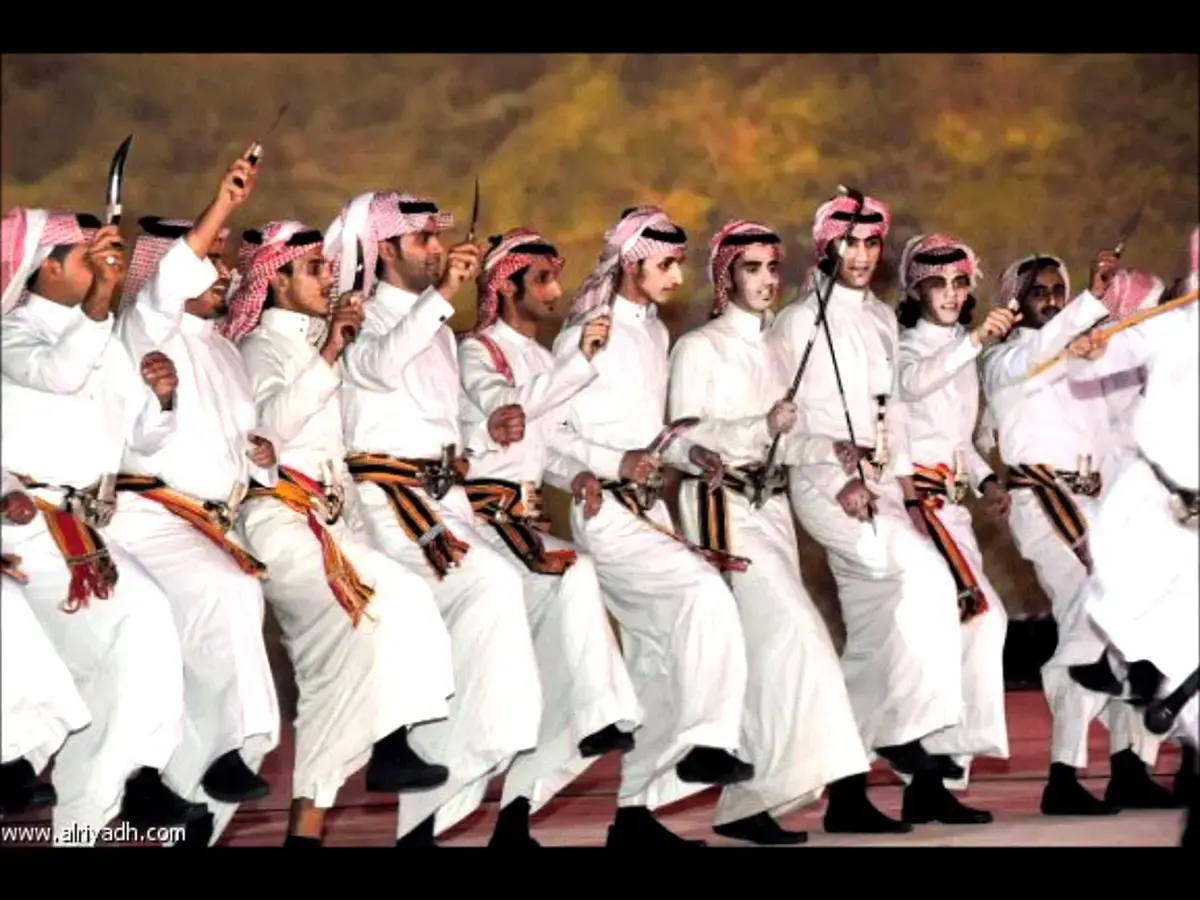
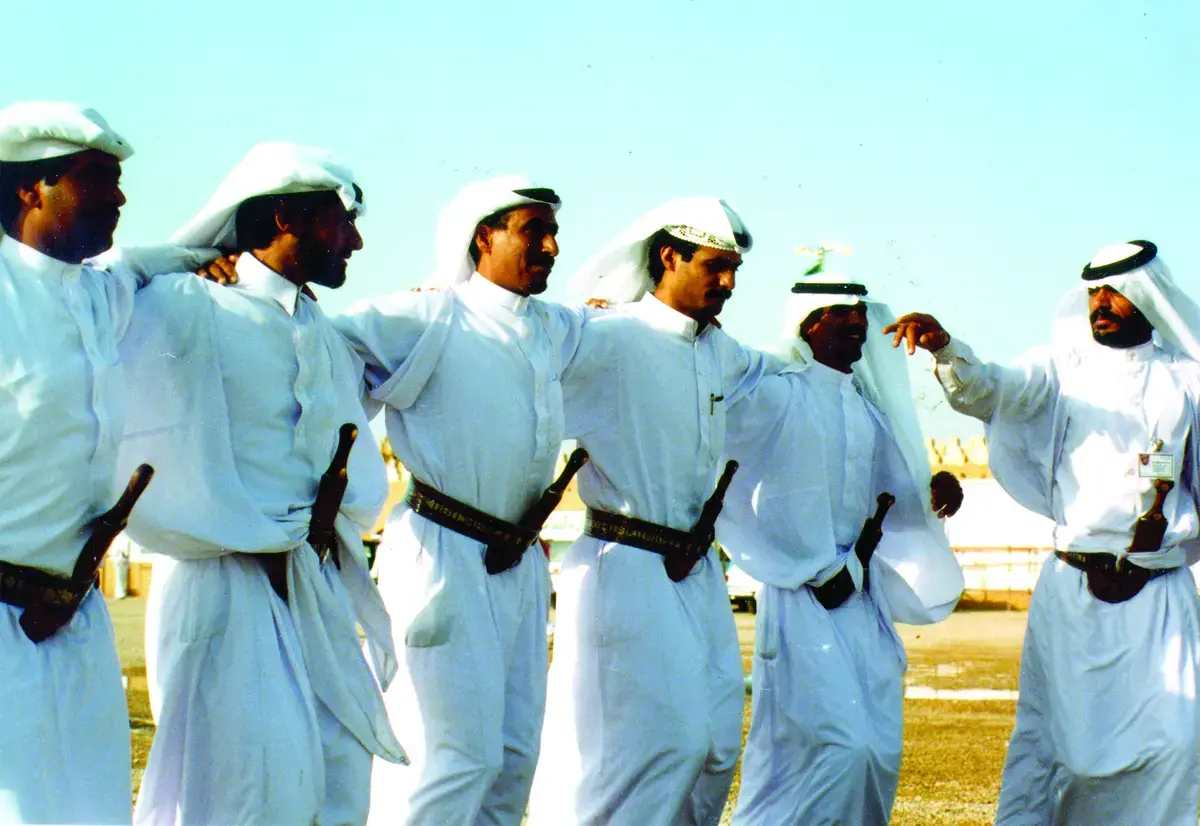
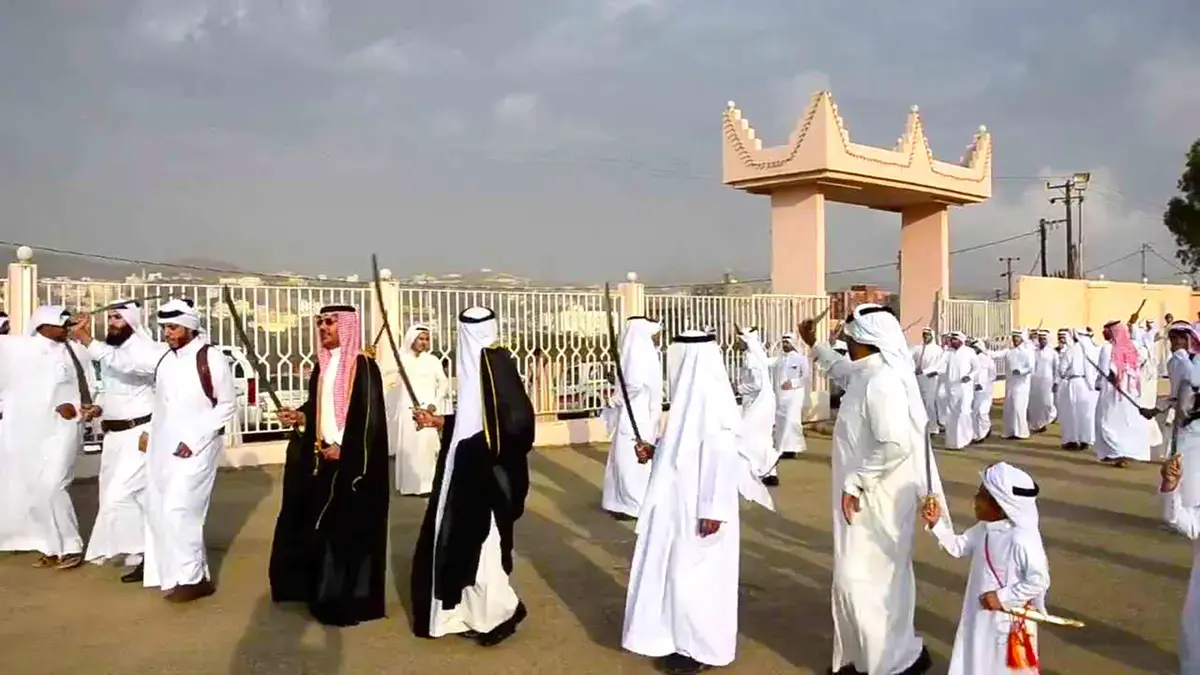
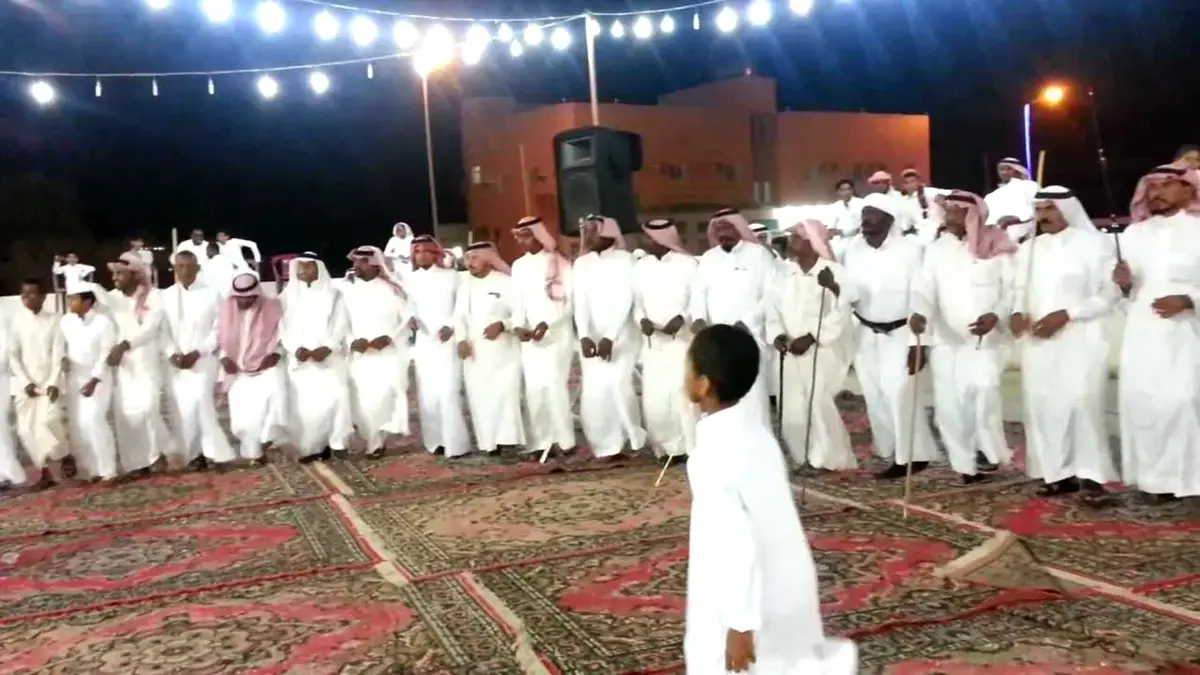
Folk arts, in their richness, form a state of general joy expressed by group dances, the most famous of which are (Al-Ardha, Al-Mirad, Al-Saif, Al-Damma, Al-Khatwa, Al-Zahfa, Al-La’alab, Al-Rabkha, Al-Mathuluthah, Al-Zamil, Al-Hashiliyah, Al-Razha, Al-Marzouha, Al-Razf, Al-Hawi, Al-Qazoui, Al-Jaishi, Madram dance, Al-Sarwiyya, Al-Azwa, Al-Badawiyah, Al-Barqa, Al-Wana, Al-Waha, Al-Tariq, Al-Manazim, and Al-Qaifan.

These arts are performed at special occasions

06

These arts are performed at special occasions and weddings, and the population still preserves these arts because of their connection to their authentic customs and traditions. The Asir Region is also characterized by the abundance of its poetic colors and its various types of folk heritage, as the varying environmental, climatic, and natural conditions of the region imposed on it different heritage vocabulary that varies from one place to another.

Thus, each part has its own folk

07

Thus, each part has its own folk heritage, which is compatible with its customs and traditions, its geographical location, its historical heritage, its cultural depth, and its special circumstances. Thus, this flows into the folk heritage in poetry, melody, and rhythm as a result of all of that, which appears clearly.

In the performance and recitation of folk

08

In the performance and recitation of folk poetry, in addition to the difference in images and poetic specificity in meter and treatment in accordance with the nature of each part of the Asir region, starting from Tihama Asir in the Rijal Almaa region, Muhayil Asir, Al Majardah, then Asir Al-Sarat, then Rijal Al-Hajar, in the country of Shahran, to the Bishah region, then Qahtan, and Tihama Qahtan.

Because nature used to rule the people

09

Because nature used to rule the people of the Asir Region in a way that seems to be monolithic regarding its surroundings, poetry is alone and companionable in work, and with its mountains and deep valleys it is a productive mountainous agricultural and pastoral area, but comparing it to others in terms of the Asiry of the terrain and life is Asir. Therefore, poetry was a necessity, not a luxury.

We did not know a farmer without

10

We did not know a farmer without his spiritual nourishment with his revolutionary being poetry singing, nor a shepherd who did not possess the language of revelation for his sheep, nor a young man without declaring the beginning of his manly responsibilities with the

Qaf, nor a female woodcutter, or a woman carrying a bucket, or a cradler of a newborn, or a mourning lover, except with poetic singing as her help, longing, and tears, nor one who was tired after a day of toil.

Unless he lights up his night with

11

Unless he lights up his night with melodies that sum up that day, ruminate on his tomorrow, and renew life in the veins of his feelings... Poetic arts: Folk poetry is the poetry of the overwhelming majority in every local environment that tastes it by nature. It has poetry that speaks to the hearts in its local dialect and simple language. Folk poetry is the beating of a drum and a poet sings or a vocalist memorizes a piece of poetry.

The group has come together and started to dance with all its senses and is in an overwhelming ecstasy.

The poetic arts are multifaceted with the

12

The poetic arts are multifaceted with the multiplicity of life’s purposes, including, for example: Al-Manazim: These are sung poems that mostly deal with asceticism, wisdom, and pride, including the words of the poet Abr Mani’ al-Hazmi: I swear to God, I think, O wise people, the truthful person no longer says anything They invalidate the truth with the treachery of betrayal.

This world is as it continues to pass away Proverb

13

This world is as it continues to pass away Proverb: The Messenger is still, oh, people's friend due to lack of honesty The Qaf: It is a poem composed by the poet for a young man who has reached the age of circumcision. The age of circumcision among the residents of the Asir Region was often no less than fifteen years.

The Qaf contains all the important values of the tribe, which rejoices at the inauguration of this young man because he has become an effective member of it. Their law among the women is: (from circumcised and above).

The Qaf is also the beginning of

14

The Qaf is also the beginning of socialization of pride, authenticity, behavior, and a sense of responsibility, as the poet enumerates it in it. The positive traits that the circumcised’s family, his tribe, and his uncles have, which means to him: Be like this...etc Al-Ardha and Al-Ardha: Al-Ardha is an enthusiastic type of singing performed during delegations, and the enthusiastic Tareeb is performed spatially.

As for Al-Ardha, it is a practical, enthusiastic song that is used during delegations and going to carry a heavy burden or benefit.

The Madqal

15

The Madqal: The Madqal is associated with the Ardha, where it is thrown with what are called maqami` (a shotgun in which gunpowder is used instead of bullets). Damma: There are many types, short and long. It is considered the most exciting type of folk art and is exemplary in its contents, melodies, and performance.

Al-Zamil: A name given to a type of folk lyric poetry that is sung in gatherings and danced to on some occasions as a group dance consisting of a semi-circle and sometimes two rows facing each other.

It is sung with a melodious, repetitive

16

It is sung with a melodious, repetitive tone with an elongated syllable, and its dance has a kind of active movement and swaying push. The step: It has many colors in its melodies and lengths, but its performance is uniform. It is a Tareeb based on its Tareeb, replacing the day of fatigue with a spiritual night dominated by sentiments and humanity... Al-Wahi: It is a melodic performance devoid of words.

Rather, words with a special terminological significance are sometimes performed with it that the shepherds and their livestock are familiar with.

Their names are

17

Their names are: names of verbs, such as: “Wahi” for the sheep, meaning “to come.” Wailing songs: poignant poetry in which a woman laments the loss of a brother, son, or lover... Baby rocking: These are well-known songs in which a mother rocks her son in his cradle so he can sleep on it, such as: Oh, good sleep, two bears will crawl to you Sheep and sheep bear Work songs: They are very many.

The plowman has his songs with his

18

The plowman has his songs with his oxen, and the one who draws water from the depths of the well has his songs, and the one who carries the burdens has his songs according to the type of burden, its place and its duration... and the harvester has his songs with which the place was filled with joy during the harvest seasons..

Al-Tariq or Al-Tariq

19

Al-Tariq or Al-Tariq: Al-Tariq’s singing in Tihama and the Asir Region corresponds to “reproach and meyjana” in Syria and Lebanon, and Al-Mawwal in some sister countries, and the adjective in Hijaz, and this singing has its magic and arts, not on men, but on women, and here

Al-Tariq climbs one of the hills and raises his voice with “no”, “no”, which is the note specific to this beautiful singing, and the voice of that singer breaks through the silence in an enchanting melody.

A beautiful natural melody that cheers the

20

A beautiful natural melody that cheers the soul and delights the heart, charm and creativity in an overwhelming ecstasy that takes them away from the monotony of boring life that is required by the desert environment between plowing and grazing. It is long, high in tone and performed throughout the caravan route, and contains expressions of fatigue, longing, and relative support for travel and distance...

such as

21

such as: O dish, you do not have honey, you are not a dish of serch, you traitor, we did not advise us Bedouin songs: We cannot list them due to their abundance and diversity. The (musical-poetic) meter in this poetry depends on the musical tone that complements the pronunciation, and this is called in our popular literature the shifa.

It is: {malala}: vocal control in the performance with {la-la-la...} emptied of words, with references according to the need and desire of the melody. The vowel may be a long kasra, a huge kasra, a fatha...etc.

The Asir Region also witnesses every summer

22

The Asir Region also witnesses every summer the governorates’ celebrations, which are held annually in the outdoor theater to showcase the songs, folk arts, dances and various programs of the governorates of the region under the patronage of His Royal Highness Prince Turki bin Talal bin Abdulaziz Al Saud, Emir of the Asir Region.

Arts in Asir Region / Aesthetic identity as an extension of history and man

In Asir, the arts are not practiced

23

In Asir, the arts are not practiced as a passing leisure activity, but rather are lived as an inherent part of the structure of society, taking shape in the details of daily life, emerging from the memory of place, and translating a person’s sense of his mountainous and coastal environment.

From this standpoint, the arts in Asir represent one of the three pillars History - Civilization - Development, as it is considered a mirror that reflects social transformations and embodies the continuity of identity over time.

First

24

First: The arts as a historical extension Art as an unwritten document: The arts in Asir are linked to a long history that preceded writing, as they played the role of a “living archive” that preserved: Tribal values Championships lifestyles This function appears clearly in performing arts such as the ardha and the step, where the poem and movement are transformed into an oral historical record.

Arts in the context of ancient Asir society The arts were part of

25

Arts in the context of ancient Asir society The arts were part of: Wars (Ardha) Weddings (Al-Dammah and Al-Khatwa) Daily life (ornamentation and architecture) This overlap makes art a structural element in the formation of society, not just an external appearance.

Second

26

Second: Arts as an incubator of civilization The Art of Al-Qatt Al-Asiri: Beauty as Identity Al-Qatt Al-Asiri is one of the most prominent manifestations of local civilization, as the wall has been transformed into a space of visual expression that carries: Social symbols Aesthetic taste An active female role in identity formation It has been recognized by UNESCO as a human heritage, reflecting its universal value.

Architecture

27

Architecture: the art of place Asir architecture represents a marriage between function and beauty, integrating: Environment (stone, clay) Art (ornamentation, colors) Defense (turrets) It is prominent in sites such as Rijal Almaa, which has become a global cultural icon.

Third

28

Third: Arts as the voice of man Performing Arts: The Collective Rhythm of Identity The performing arts in Asir constitute a collective expressive system, the most prominent of which are: the southern ardha, the Asir step, and the damma, which are arts based on: Collective rhythm, improvised poetry, and social cohesion.

Poetry: speaking memory Poetry is organically linked to the arts, as: It nourishes artistic performance Documents events Reflects values It is an inseparable part of the Asir human identity.

Fourth

29

Fourth: Arts in the context of contemporary development From heritage to cultural economy The arts in Asir are no longer confined to their traditional framework, but have become: A tourist attraction An economic resource A tool to strengthen national identity Arts within Saudi Vision 2030 Asir arts are consistent with the goals of the vision through: Supporting cultural industries Empowering craftsmen and artists Developing heritage destinations The arts in

Asir are not just aesthetic expressions, but rather an integrated cultural system that combines memory, experience, and identity, and embodies the human ability to transform the environment into art, history into creativity, and life into a vibrant painting of presence.

Between the decorated walls of the houses

30

Between the decorated walls of the houses, the rhythm of the step, and the sound of the poem, Asir keeps rewriting herself... not with letters, but with colors, movement, and people.

Category: عسير