The history of electricity in the Kingdom... / It began with two generators and reached (13,112) cities and villages

The history of electricity in the Kingdom... / It began with two generators and reached (13,112) cities and villages

When people started building their homes in ancient times, they did not think about how to provide lighting inside them.

When people started building their homes in ancient times, they did not think about how to provide lighting inside them. They obtained this lighting through the penetration of sunlight into the home through openings between the trunks of trees and palm trees that were used to build homes. Society in the Arabian Peninsula was characterized by desert life, which did not require energy except within its limited scopes.

However, the development brought about by the establishment of the Kingdom of Saudi Arabia at the hands of the founder, King Abdulaziz bin Abdulrahman Al Saud - may God have mercy on him - brought with it a shift little by little to a life of urbanization and modernity, which are necessities for the establishment of any stable political entity. With this development, the way of life required resorting to the increasing use of energy, most notably electrical energy. With the passage of time, lighting became one of the necessary means in his daily life, especially at night, whether at home, work, or the streets.

3Sections
6Images
18473Characters
عسيرCategory

The history of electricity in the Kingdom... / It began with two generators and reached (13,112) cities and villages

When people started building their homes in

01

When people started building their homes in ancient times, they did not think about how to provide lighting inside them. They obtained this lighting through the penetration of sunlight into the home through openings between the trunks of trees and palm trees that were used to build homes. Society in the Arabian Peninsula was characterized by desert life, which did not require energy except within its limited scopes.

However, the development brought about by the

02

However, the development brought about by the establishment of the Kingdom of Saudi Arabia at the hands of the founder, King Abdulaziz bin Abdulrahman Al Saud - may God have mercy on him - brought with it a shift little by little to a life of urbanization and modernity, which are necessities for the establishment of any stable political entity. With this development, the way of life required resorting to the increasing use of energy, most notably electrical energy.

With the passage of time, lighting became

03

With the passage of time, lighting became one of the necessary means in his daily life, especially at night, whether at home, work, or the streets. He resorted to using lighting methods that depend on industry with primitive materials, such as the use of oils or animal fat.

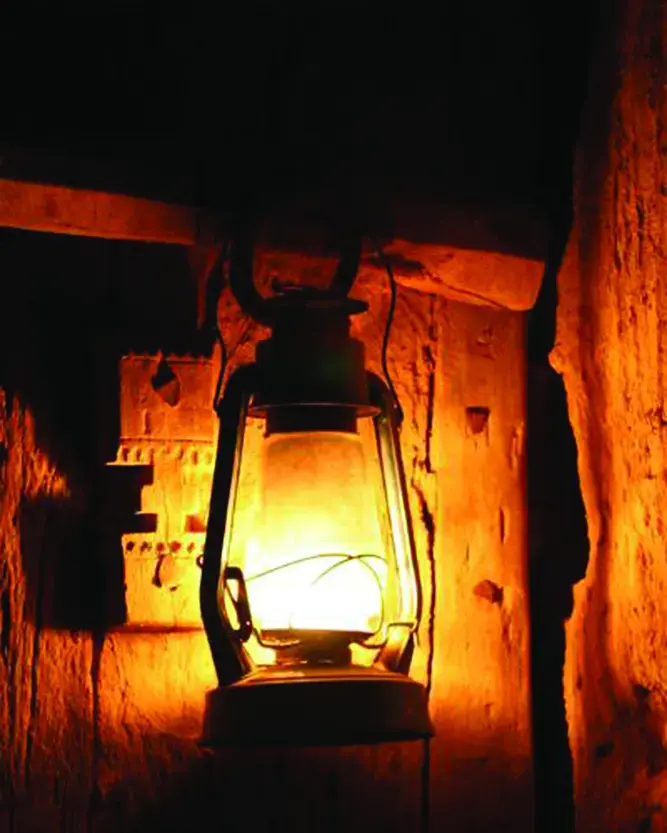
Among these means are: The lamp: (a lamp) which is a vessel made of stone, and contains a hole into which the wick is placed, so one end of it remains in the oil in the vessel, and its other end is on the edge of the lamp to ignite it.

Lamp

04

Lamp: (hookah) It is defined as a circular base used to store kerosene inside, and at the top of it is a crown made of metal that contains a space to place a thin, removable bottle that helps prevent the flame from going out, and in the middle is a wick whose end is immersed in the kerosene. Lantern: It looks somewhat like a lamp, as it consists of a circular base for storing kerosene, and on it is a thin bottle attached to two handles on both ends.

Lux: It is an advanced lantern that gives greater light than a lantern.

The Etrek

05

The Etrek: It is a metal instrument made to prepare and illuminate the place around it. Not everyone at that time owned the Etrek, but some people knew that they had it. "Atarik" - plural of atarik - and "atarik" are two types, some of which are used to light streets, and some are a small type used to light homes and homes. The "Atarik" light was white, comparable to electric light.

It was used in the homes of

06

It was used in the homes of wealthy people and upper-class people due to its high price, but after it spread and became popular for sale, its price fell and middle-income people were able to be illuminated by its magical light. Some government departments that were working on the nights of the blessed month of Ramadan were also decorated with it.

The fame of the Etrick increased and it began to illuminate the roads of cities and villages over a period of time by contractors who contracted with the municipality.

He became known as the “Patrick of

07

He became known as the “Patrick of the Municipality,” a teacher inside the neighborhoods, alleys, and mountain peaks who illuminates the roads of the people of these places and makes it easy for them to fulfill their needs and affairs and go to perform prayers in the mosques for the evening and dawn prayers. This is from the generosity and blessings of the Almighty God. The contractor was committed to providing sufficient and agreed-upon numbers.

He also provided many workers capable of

08

He also provided many workers capable of distributing a number of tents, which were larger in size than household tents, as they were carried by a crane on the shoulders of the workers, and then they installed them in their designated locations on the poles, tightened and tied tightly, and they continued to be lit until dawn, then they returned to return them to their maintenance places so that they could return to work in the evening period of each day.

With the development witnessed by the ages

09

With the development witnessed by the ages, people have resorted to searching for advanced means of lighting that are more useful than what they used in the past. Lighting in our current era has also become one of the elements that plays a role in interior design, whether for homes, workplaces, etc., due to the presence of lighting means in different shapes and colors. Different bulbs appeared in sizes and shapes, and each had its own use.

There are circular bulbs that give high illumination, and non-circular bulbs, which are known as zero bulbs.

They give less light than the first

10

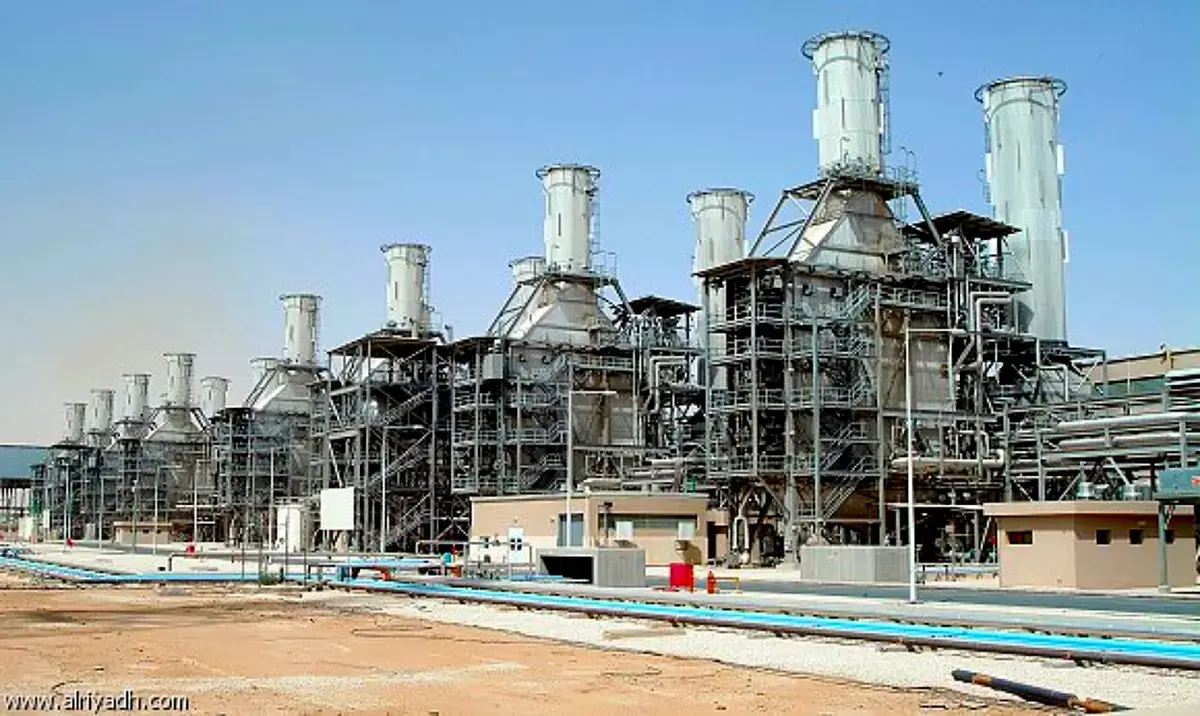
They give less light than the first and save on electricity consumption. After the appearance of this type of bulb, another type of bulb appeared, which is known as fluorescent, and is characterized by giving high illumination, with a high degree of clarity and spread, and at a lower cost than the previous bulbs, then bulbs. LED etc. Society in the Arabian Peninsula was characterized by desert life, which did not require energy except within its limited scopes.

However, the development brought about by the

11

However, the development brought about by the establishment of the Kingdom of Saudi Arabia at the hands of the founder, King Abdulaziz bin Abdulrahman Al Saud - may God have mercy on him - brought with it a shift little by little to a life of urbanization and modernity, which are necessities for the establishment of any stable political entity. With this development, the way of life required resorting to the increasing use of energy, most notably electrical energy.

Electrical power was not available in the

12

Electrical power was not available in the Kingdom of Saudi Arabia except in Medina, where the Prophet’s Mosque was lit since 1327 AH (1907 AD) from two generators, one running on coal and the other on kerosene with a capacity of twenty kilowatts, with a charged battery to illuminate the mosque for dawn prayer.

This date means that there was a period of less than (40) years between the establishment of the first power generation station in the world in the year 1299 AH (1889 AD).

And the entry of electricity into the

13

And the entry of electricity into the territory of the Kingdom of Saudi Arabia. As for the Grand Mosque, which is the second place that witnessed the entry of electricity into the Kingdom, it was illuminated in the year 1338 AH (1918 AD) using special generators belonging to the administration of the Holy Mosque in Mecca that were installed in the Ajyad area.

Also in Mecca, the first street and

14

Also in Mecca, the first street and house lighting appeared, with the appearance of ice factories and automated grain mills that used surplus electricity production to illuminate the streets and nearby neighborhoods. The lighting period was limited to the Maghrib prayer and for only three hours.

We mention Here, the first ice factory in Makkah Al-Mukarramah was established in the 1940s AH in the Sulaymaniyah locality, and it supplied the neighboring stores with electricity.

Hussein Daghistani also established an automatic grain

15

Hussein Daghistani also established an automatic grain mill in the Al-Tayseer Bagroll locality on Ahmed Kubar Street, and he also supplied the neighboring stores with electricity that exceeded their need. It can be confirmed that these generators in Medina, Makkah Al-Mukarramah, and Jeddah are the true beginning of the emergence of electricity in the Kingdom of Saudi Arabia.

Electricity generation was a by-product of the

16

Electricity generation was a by-product of the facilities that provided electrical energy (ice factories, grain mills), and there was no real project to produce electricity as a primary production with economic feasibility.

The Saudi government at the time saw the importance of investing in electricity generation, and a committee was formed to study electricity generation and held its meeting in the presence of His Majesty the King in Hijaz at the time, Prince Faisal bin Abdulaziz - may God have mercy on him - in the month of Shaban of the year 1347 AH.

The idea of the project was that

17

The idea of the project was that the state would assume two-thirds of its cost and the rest would be offered as shares. For citizens, at a value of three pounds per share.

Accordingly, the government decided to spread the

18

Accordingly, the government decided to spread the experience in all regions of the Kingdom so that all regions of the Kingdom could enjoy electricity and achieve good financial investment for citizens, so it issued the system for granting electrical energy concessions, which was issued in the year 1352

AH, which is the real beginning of investment in the electrical field based on real economic components that make electricity an independent industry in its own right and managed in accordance with modern developments, which confirms King Abdulaziz’s keenness to provide this service to his people by relying on the resources available at that time to provide the infrastructure for that industry and the necessary equipment.

Businessmen responded enthusiastically to this development, which

19

Businessmen responded enthusiastically to this development, which made the state expand in granting this concession in a number of cities in the Kingdom, the first of which was the city of Jeddah, where Muhammad Abdullah Ali Reda and Ibrahim Shaker were granted the right to light it with electricity, and in Taif, Ibrahim Al-Juffali and his brothers were granted the same right in the year 1365 AH.

In 1366 AH, approval was issued to

20

In 1366 AH, approval was issued to establish a joint-stock company in Jazan granting it the right to bring water and electricity to the town, and in the same year it was issued. The Shura Council approved granting Abdulaziz Al-Khuraiji the registration of a joint-stock electricity company in Medina. In the Eastern Region, Aramco took over covering all its facilities and administrative and residential complexes in Dhahran and Ras Tanura with electric power.

In the 1980s, the state provided great

21

In the 1980s, the state provided great support to the electricity sector and granted loans, facilities and subsidies to support this energy. It also issued a system for protecting and encouraging local industries in the year 1381 AH, which granted the private sector great incentives and facilities.

As for the city of Riyadh, Khair al-Din al-Zirkli mentions its story with electricity in his brief book on the biography of King Abdulaziz, where he says: “The city of Riyadh must be the first city in the desert to see the light.

The king ordered Riyadh to be illuminated

22

The king ordered Riyadh to be illuminated with electricity in the year 1367 AH (1948 AD), and not many months had passed before four large freight cars carrying diesel-powered machines and generators from Ras Mashab, arriving from San Francisco, were the nucleus of an electricity generation station in the capital.

It generates 1,600 kilowatts, and was added

23

It generates 1,600 kilowatts, and was added to it in 1368 AH (1949 AD) diesel-powered machines, also with a power of 1,140 mechanical horsepower, connected to an alternating current generator, for lighting homes and streets, wells, and other purposes. The circuit maintains original documents for the Riyadh electricity budget for the year 1368 AH, which amounted to 13,368 riyals, which is the first official budget for the city of Riyadh’s electricity..

The “Riyadh National Electricity Company” was also

24

The “Riyadh National Electricity Company” was also established, which began with a capital of (ten million) Saudi riyals to illuminate the capital. It agreed with the Swiss company “Sulzer Brothers” to supply, install and manage the huge machines.

Amin Saeed described in his book “The Saudi Renaissance during the Era of King Saud” how the old Airport Street - King Abdulaziz Street - was embroidered with lighting poles that made it a lit belt in the middle of the peaceful city, just as Al-Bathaa Street was.

And the streets of the neighborhoods of

25

And the streets of the neighborhoods of Al-Murabba’, Al-Nasiriyah, Alisha, Al-Fakhriya, Al-Khazzan Street, and the beginnings of the Al-Malaz neighborhood, which was called “the Red Sea” or “the New Riyadh.” William Vesey described in his book “Riyadh the Old City” the beginnings of the prosperity of urbanization and the introduction of electricity in Riyadh in a detailed way through which he traces the steady development of the growth of the capital.

The only evidence of this is the

26

The only evidence of this is the admiration of the founding king, may God have mercy on him, for the “fluorescent” lighting that he saw in the palace of his son and crown prince at the time, King Saud. When he inaugurated his new palace in Nasiriyah, the beginnings of electricity had opened a way for young children to play in the city’s alleys in the middle of the dark night, and housewives also found another opportunity to meet neighbors and relatives.

As for the men of that time

27

As for the men of that time, they still remember well their collections and gatherings, which brought to the minds of some the nights and evenings of “Al-Wasl bil-Andalus,” whose cities were described at the time as cities of light and crystal. In the Eastern Region, the Dhahran Governorate Electric Power Company was established in 1369 AH, and it was responsible for generating and distributing electricity in Dhahran, Dammam, and Al-Khobar.

Aramco also produced electricity for its own businesses.

In the final outcome, the era of

28

In the final outcome, the era of the founder, King Abdulaziz bin Abdulrahman Al Saud - may God have mercy on him - had not ended unless the nucleus of the electricity generation industry in the Kingdom of Saudi Arabia had been formed on a strong base that enabled it in the future to reach many places in the country, which paved the way for the merger of all companies into one company, which is the Saudi Electricity Company.

Instead of (20) kilowatts, which is the

29

Instead of (20) kilowatts, which is the first electricity production in the Kingdom, the company was able in the year 1439 AH to sell approximately (290,000,000.00) kilowatts, reaching (13,112) cities and villages. Al-Riyadh newspaper, published by Issue No. 16264, Thursday 21 Safar 1434 AH, prepared by: Mansour Al-Assaf.

Southern Electricity Company

The company was established based on Royal

30

The company was established based on Royal Decree No. 43/M on 8/22/1399 AH, corresponding to 15/7/1979 AD. With a capital of four billion Saudi riyals, divided into (40) million shares with a value of (100) riyals per share.

On 1/1/1411 AH, twenty-one companies and cooperative

31

On 1/1/1411 AH, twenty-one companies and cooperative societies active in the electricity sector were merged, in addition to three central projects: Asir Central Project Jazan Central Project Al Baha Central Project The company is located in the southwest of the Kingdom and its concession area is estimated at approximately (270,000) km2, divided into six regions: Asir Jazan Najran Al-Baha Tihama Bishah The number of subscribers at the company's franchise level reached (436,282) subscribers.

On 12/19/1421 AH The total number of workers (3893) workers.

The electricity sector in Asir Region represents

32

The electricity sector in Asir Region represents one of the main sectors that witnessed significant growth and expansion during the last period, and this came in parallel with the development achievements achieved in various fields in the region. The total electrical energy sold in the region during the year 1419 AH amounted to 3,156,203 kilowatts. and. This included the residential, commercial, governmental, industrial, and agricultural sectors.

It is noted that the residential sector

33

It is noted that the residential sector received the largest share of this total energy, as the amount of energy sold to this sector amounted to 2,247,700 kilowatts. and. (kilowatt hours), which represents 71.2% of the total energy sold in the region, while the agricultural sector was the least energy consuming sector, as the value of energy sold to this sector amounted to 5169 kilowatts. and. Q, which represents only 0.2% of the total energy sold in the region.

The performance indicators at Asir Electricity improved

34

The performance indicators at Asir Electricity improved by 20%, while they improved during the first quarter of 2020 by a rate of 30% compared to the same period in 2019.

On 7/25/2020 AD, His Royal Highness Prince

35

On 7/25/2020 AD, His Royal Highness Prince Turki bin Talal, Emir of Asir Region, Chairman of the Region Development Authority, discussed the work mechanisms of the electricity company in the region, during his meeting with officials of the Saudi Electricity Company, headed by His Royal Highness Prince Abdulaziz bin Salman bin Abdulaziz, Minister of Energy, and his participation via video communication.

He reviewed the progress of its projects being implemented in Asir, the projects being proposed and awarded, and their approved budgets.

His Highness also discussed the obstacles facing

36

His Highness also discussed the obstacles facing the implementation of electricity works. And urgent solutions to it.

His Highness was briefed on the projects being implemented and the completion rates for each project, in addition to the projects approved in the 2020 budget, the total number of which is 31 projects at a cost of 3.9 billion riyals, including 17 projects at a cost of 2.4 billion riyals, and 14 of the projects approved in the 2020 budget at a cost of 1.5 billion riyals.

The projects being implemented include the expansion

37

The projects being implemented include the expansion of the East Abha station, the loop link between the Al-Quraa, East Abha and Jazan Refinery stations, linking the East Abha station to the Jazan Refinery station, linking the West Mahayil station to the Jazan Refinery station, linking the Bishah station to the Shuqaiq station, reconnecting an aerial line between the central Asir and south Abha stations, establishing and linking the central

Bishah station, establishing the Wadi Bin Hashbal station, and constructing a station.

Al Farshah, the establishment of Al-Harida station

38

Al Farshah, the establishment of Al-Harida station, linking Al-Harida station and Khamis Al-Bahr, the expansion of North Abha station and Sabt Al-Alaya station, Asir Hospital station, and the establishment of Al-Souda and Al-Rahwa stations.

The projects approved in the 2020 budget

39

The projects approved in the 2020 budget included a project to strengthen the North Mahayil station, establish a central Mahayil station, establish, strengthen and connect 132 kV high-voltage network stations, in addition to a project to connect the North Abha station to Al-Faraa station to enhance the reliability of the station, a project to connect Al Farshah station to the transportation network, a project to connect Wadi Bin

Hashbal station to the transportation network, and a conversion project to connect the Al-Irfan stations and King Khalid Air Base to further establish and strengthen stations.

Al-Effort, the Al-Irfan station expansion project, the

40

Al-Effort, the Al-Irfan station expansion project, the project to establish

Tandaha station, enhancing the reliability of stations and single-source feeders, the project to connect distribution stations with fiber cables, the project to strengthen, improve and connect distribution networks, the project to connect new stations to existing distribution networks, the project to replace old distribution networks with new networks, and the project to improve meters, convert voltage and install smart meters.

His Highness, Chairman of the Asir Development

41

His Highness, Chairman of the Asir Development Authority, reviewed the mechanism for dealing with electrical outages in the region, including the outages of the last month of Ramadan, and the solutions that have been implemented, such as restarting the generating units in the Bishah and Asir stations, providing mobile generators, medium-term projects whose implementation will be completed in 2020

AD, and long-term projects whose implementation will be completed in 2021 AD and 2022 AD.

Urgent solutions were also presented by counting

42

Urgent solutions were also presented by counting the total number of units that have been restarted, Generation capabilities and operating history, and enhancing the reliability of the electrical system, while His Highness reviewed the obstacles facing the company in implementing its projects, the mechanism for supporting it, facilitating its services, and developing urgent solutions for their implementation.

Electricity industry in the Kingdom

The Saudi electricity system is considered the

43

The Saudi electricity system is considered the largest system in the Arab countries, as the peak load in the year 1433/1432 AH (2011 AD) reached 48,367 megawatts. The following is a description of the elements of this system.

Obstetrics The generation capacity available to the electricity system in the Kingdom during the year 1432/1433 AH amounted to 57,432 megawatts, of which the Saudi Electricity Company owns about 75%, the Saline Water Conversion Corporation owns about 9%, and the rest is distributed among a number of producers.

Transportation The Saudi Electricity Company currently monopolizes

44

Transportation The Saudi Electricity Company currently monopolizes the activity of transmitting electrical energy in the Kingdom (with the exception of Yanbu Industrial City, in which the Electricity and Water Utilities Company of Jubail and Yanbu “Marafiq” is responsible for transmitting electricity).

During this year, the National Electricity Transmission

45

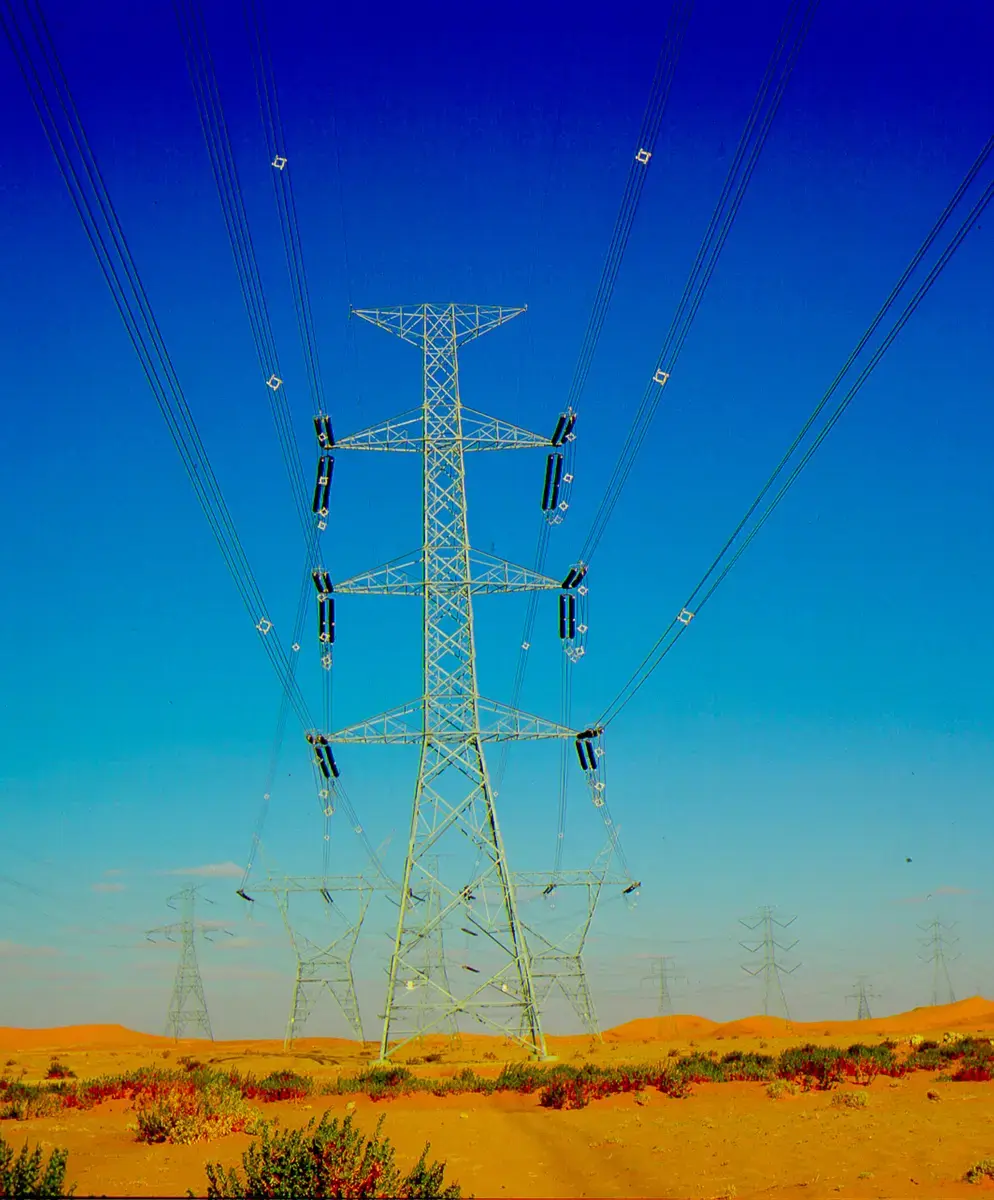
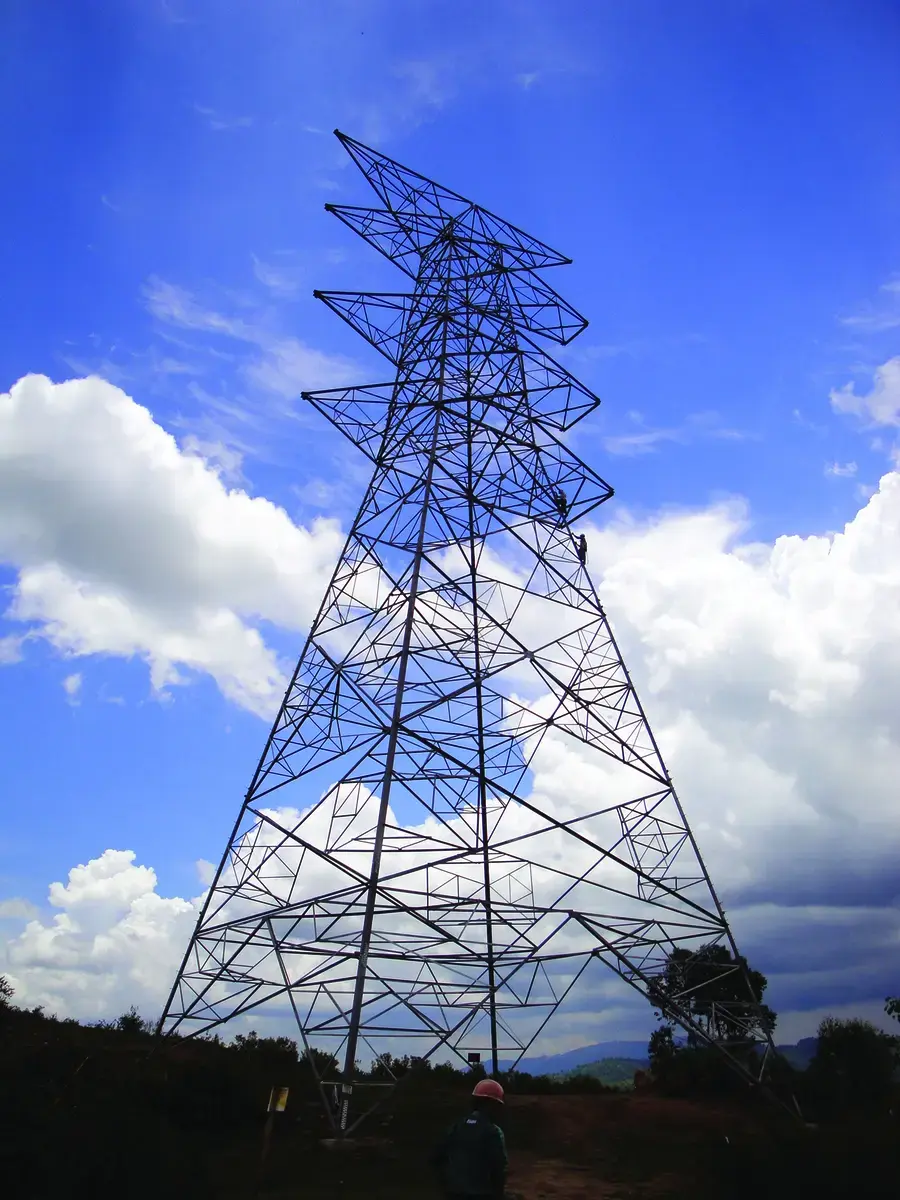
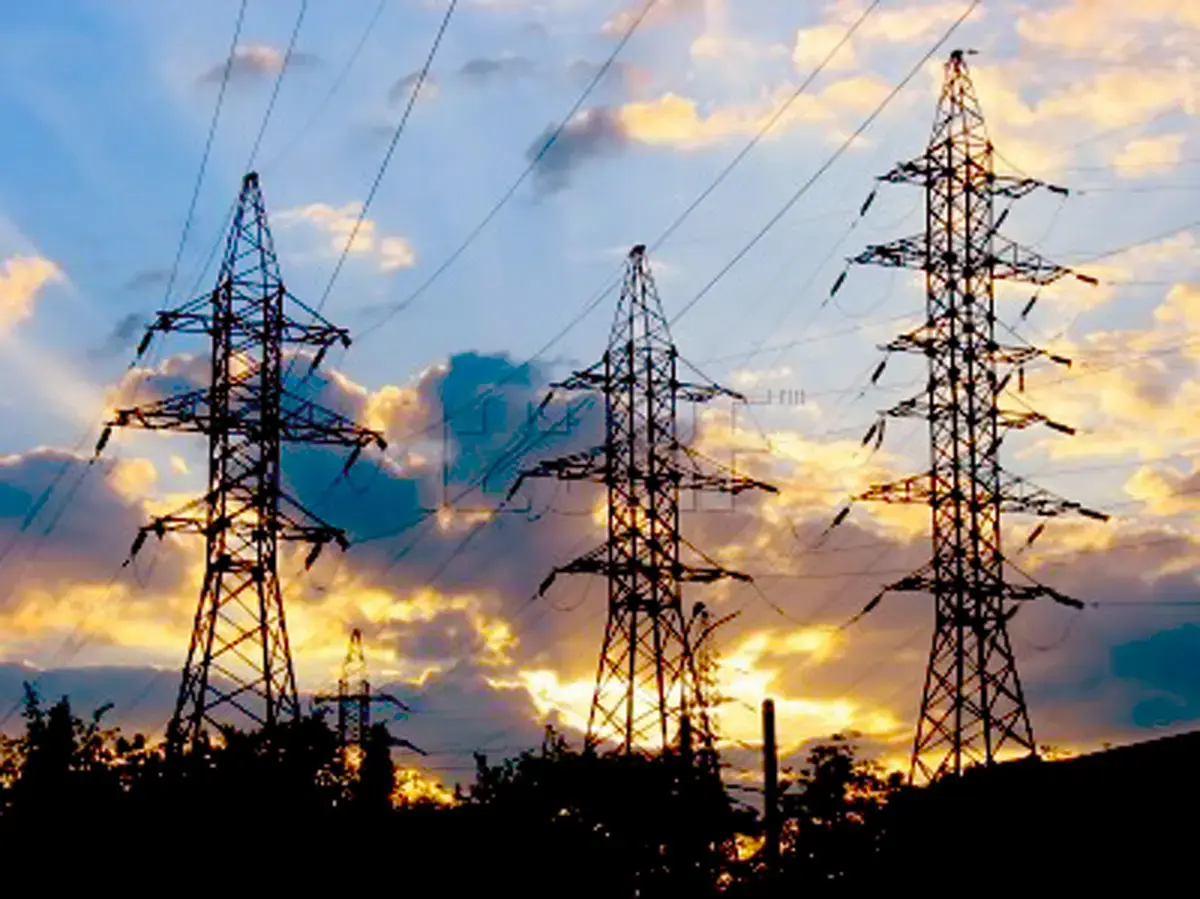
During this year, the National Electricity Transmission Company was established to undertake, at the beginning of the fiscal year 1433/1432 AH (2012 AD), the planning, construction and operation of the transmission system with all its components and for all voltage levels higher than 110 kilovolts (kV). Energy is transmitted from generation stations to consumption areas via high-voltage overhead lines with a total circuit length of (45,442) kilometers.

Landlines with a total circuit length of (4,232) kilometers are also used.

The national electricity transmission network consists of

46

The national electricity transmission network consists of conversion stations, connection and separation stations, and transmission lines that operate at high voltage (110, 115, and 132) kV and ultra-high voltage (230 and 380) kV.

With the completion of the construction of

47

With the completion of the construction of the connection line between Al-Shuqaybah station in the Jazan region and the Shuaiba station in the Makkah region during the fiscal year 1431/1432 AH (2010 AD), the southern business district was linked with the western business district, and the western and central regions were also linked with the completion of the Qassim - Medina link line.

The Saudi Electricity Company is currently conducting

48

The Saudi Electricity Company is currently conducting preliminary studies to establish the Riyadh - Jeddah link line on a continuous voltage of 500 kV, thus completing Practically linking the main networks in the Kingdom and unifying them into an integrated national network, and at the same time a national control center for the electricity system is being established that enhances the ability of the National Electricity Transmission

Company to manage and control the electricity system from the east to the west of the Kingdom and from the north to the south and to coordinate the work and activities of the regional control centers currently located in the company’s eastern, central, western and southern business areas.

distribution The Saudi Electricity Company currently undertakes

49

distribution The Saudi Electricity Company currently undertakes exclusively the activity of distributing electricity to consumers (with the exception of the two areas of operation of the Electricity and Water Utility Company in Jubail and Yanbu “Marafiq”).

During the fiscal year 1432/1433 AH, the company provided 219,662 gigawatt hours of electricity, an increase of 3.5% over the previous year, and the number of subscribers receiving service from the company increased by 5.7% to reach (6,341,025) subscribers.

Residential consumption amounts to about half of

50

Residential consumption amounts to about half of the amount of energy sold, and air conditioning loads represent a large percentage of about 70% of residential consumption. The distribution networks consist of 213,608 km of overhead networks and 195,681 km of buried underground networks.

It is clear that the consumption of the three business regions - eastern, central, and western - is almost equal (within 30% for each region), while the consumption of the southern business region is about a quarter of the average consumption of any of the other regions.

It is clear that the consumption of

51

It is clear that the consumption of the western region is the largest consumption among the business regions at 37%, followed by the central region at 30%, while the consumption of the southern business region is about a third of the average consumption of any of the other regions. Consumption patterns differ between categories of consumers in the different business areas.

While industrial consumption dominates in the Eastern

52

While industrial consumption dominates in the Eastern Business District, reaching about 47% of all consumption in the region, we find that residential consumption is predominant in the other business areas, reaching more than 55% in the Central Business District, about 60% in the Western Business District, and reaching 67% of all consumption in the Southern Business District.

The distribution of residential and commercial consumption

53

The distribution of residential and commercial consumption in the Saudi Electricity Company’s business areas during the fiscal year 1432/1433 AH reflects the relative distribution of population density between the regions, while the high government consumption in the Central Business District reflects the presence of the Kingdom’s capital there, and the high industrial consumption in the Eastern Business District is due to the presence of the two industrial giants,

Saudi Aramco and SABIC, in this region.

Delivery of services to consumers At the

54

Delivery of services to consumers At the end of the fiscal year 1431/1432 AH, the cumulative number of service delivery requests to consumers at the Saudi Electricity Company that was unable to implement them reached 53,092 requests. During the fiscal year 1432/1433 AH, the company received 155,318 requests.

Of the total of these requests, which amounted to 162,049 requests, the company was able during the year under report to implement 136,320 requests, meaning that the implementation rate was 65%.

Growth trends over the past decade During

55

Growth trends over the past decade During the past decade (1424/1423 AH - 1433/1432 AH), the number of consumers of Saudi Electricity Company services increased by 57.5% from 4,092,319 subscribers in 1423/1424 AH to 6,341,025 subscribers in 1433/1432 AH, and the amount of energy sold increased by 70.8% from 128,629 gigawatt hours in the year 1423/1424 AH to 219,662 gigawatt hours in the year 1433/1432

AH, and the demand for peak load increased from 23,938 megawatts in the year 1423/1424 AH to 48,367 megawatts in the year 1433/1432 AH, that is, an increase of about 102.1%.

Types of fuel used In the fiscal

56

Types of fuel used In the fiscal year 1433 AH / 1432 AH (2011 AD), crude oil and natural gas were mainly used to produce electrical energy in the Kingdom, as the percentage of use of each of them was 37%, and diesel and heavy fuel oil were used to produce the rest of the energy need.

Category: عسير